Nuclear Security in the 21st Century
June 17, 2026
Thom Mason
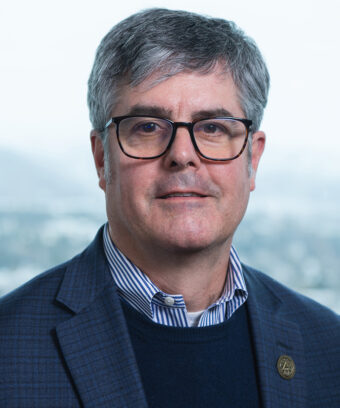
The global landscape has changed drastically since the development of the first nuclear weapons—from the rise of new great powers, to the rapid innovation and expansion of new technologies. On this episode of Talking Policy, host Lindsay Shingler is joined by Thom Mason, the director of the Los Alamos National Laboratory. Together, they discuss the shifting world order, the future of nuclear deterrence, and the new generation of nuclear security specialists.
This conversation was recorded on May 14, 2026. The conversation has been edited for length and clarity. Subscribe to Talking Policy on Spotify, Apple Podcasts, Captivate, or wherever you get your podcasts.
Lindsay: In the eighty-plus years since nuclear weapons were first developed, a lot has changed. New powers are rising, and technological innovations are changing the nature of conflict.
In a new episode of Talking Policy, I sat down with Thom Mason, the director of the Los Alamos National Lab, to ask him what the future of nuclear deterrence looks like, and how we as a global community can continue to avoid nuclear war.
Thom, thanks for being with us on Talking Policy.
Thom: Great to be here.
Lindsay: So in the mid-1980s, there were about 70,000 nuclear weapons in the world. Today, there are about 12,000—so that’s progress. But more countries have nuclear weapons today than did back then, and interest is growing among other countries in potentially acquiring them. And meanwhile, Russia has threatened to use nuclear weapons in Ukraine, North Korea has intensified its testing of intercontinental ballistic missiles, and China is building up its arsenal.
And so a case could be made, certainly, that things are getting worse. A case could be made, maybe, that things overall in the long term are getting better. What do you say? Are we in a better, safer world [or] are we in a more dangerous world?
Thom: I don’t know better or more dangerous, certainly different.
In the ’80s, of course, it was the Cold War. Principally, nuclear concerns were focused on the Soviet Union and the United States and its allies, and the framework was mutually assured destruction. You had arms control agreements which came into force, starting in the ’60s, but basically had stabilized the situation between the two superpowers in terms of expenditures, and then gradually brought that number down from the 70,000 to the position we see today.
There were always concerns that in the event of all-out conflict between NATO and the Soviet Union, that the threat of nuclear war was certainly ever present. But on the other hand, over a period of decades, there had been a certain stability that emerged, through the understanding of shared vulnerability and mutually assured destruction, and then the moderating effect of the arms control treaties.
Where we find ourselves today, the last arm control treaty, New START, has expired, so there’s no longer any limitations on strategic weapons, and instead of having two superpowers that were kind of competing with one another, we have this more complex environment where Russia [is] still a nuclear power, China [has] a rapidly growing arsenal, and, a number of other countries, North Korea being one, obviously, that has nuclear weapons, concerns about Iran.
So I think it’s a more complex situation, and that complexity brings with it maybe some risks that weren’t present back in the ’80s. And I think to some extent, we haven’t really figured out as a global community how to manage that more complex situation. It took a long time to figure out the rules of the road in the Cold War and achieve that level of stability, and I think we’re very early in figuring out the rules of the road in this new world that we find ourselves in, in the 21st century.
Lindsay: I want to back up and ask you about you. You are, of course, the director of the Los Alamos National Lab, which is one of three labs in the country responsible for the design and maintenance of our country’s nuclear weapons.
So how did you go from being a college student in lovely Nova Scotia, Canada, to being the director of one of the most important labs in the world? What was that journey like?
Thom: I guess sort of random walk, you know. Which I think is true for most people. There are not many of us that really know with precision where we’re going to wind up.
I guess the things that probably set me on this course were, first off, my parents both had scientific background. My mom was a biochemist, and my father was a geophysicist who worked at a Canadian government national lab, the Bedford Institute for Oceanography, kind of a sister institution to Scripps. And so I grew up in that environment.
I always knew that I wanted to study physics. My high school yearbook says I’m going to study applied physics, and I guess nuclear deterrence is about the most applied physics that you can do. I started off on more of the fundamental science side of physics and condensed matter physics, and wound up using large facilities for my research, and that brings you into the Department of Energy space.
As a grad student, I did experiments at Brookhaven National Lab, so I kind of got interested in instrumentation and large-scale experiments, what Alvin Weinberg once called “big science,” which was an idea that grew out of the Manhattan Project—really doing science at scale. One thing led to another, and I wound up at Los Alamos eight years ago.
Lindsay: One thing led to another, yeah.
Okay, let’s dive into some of the issues. So we know that nuclear weapons have not been used since 1945, 81 years, thank goodness. And the reason that nuclear weapons have not been used is probably partially because of the diplomacy, arms control agreements that you mentioned, maybe some luck.
But a big part of the reason that is given for the non-use of nuclear weapons over the last 80-plus years, when you talk to people who are in the business like you, is deterrence. And, for listeners who aren’t thinking about this all the time, deterrence is in a sense a sort of simple concept that we can deter nuclear war by being ready to respond with such overwhelming force that it would be not worth the price to engage in nuclear competition or war.
And of course, most people have heard of mutually assured destruction, that is part of what deterrence is. And so it involves this sort of delicate balance between countries who need to have enough of a credible threat, um, to, to make that sort of logic and balance hold, and yet the whole goal, of course, is to prevent them from being used.
I want to ask you some questions about developments that might be complicating that sort of logic behind non-use. And the first one is, to go back to what you mentioned in your opening remark, which is China. So for decades, the logic of nuclear deterrence has been built on a relatively stable bilateral relationship between the U.S. and the Soviet Union, who have owned the vast majority of nuclear weapons in the world.
But today, China is rapidly expanding its arsenal alongside Russia, and the U.S. nuclear weapons complex seems to be grappling with not only how to deter on two fronts, but how to compete, how to maybe fight on two fronts. How does this alter sort of the calculus of keeping the peace when the math is no longer one-to-one?
Thom: I think it does make a difference. Actually, first thing I would say is, I’m not sure I would say nuclear weapons have not been used since 1945. They’ve not been employed in conflict, but in a certain sense, because of deterrence, they’re used every day, and you can see the manifestation of their use in the fact that there are things that haven’t happened.
You know, in the Cold War, the tanks did not pour through the Fulda Gap. That’s deterrence in action, and I think the heart of deterrence is not just mutually assured destruction. That’s a form of deterrence, but it’s more multifaceted than that in the sense that, fundamentally, deterrence says, “Don’t bother trying because you either won’t be successful or, if you succeed in one form, you’ll find that the costs associated with that are unbearably high. So therefore, don’t try.”
But in order for the deterrent to be effective, it has to be credible. This is not liar’s poker. You can’t bluff your way out of the problem, or it would be pretty risky to try, certainly. So that’s why we have to make sure that the nuclear stockpile is safe and effective and robust and reliable, and we go to great lengths to do that.
So getting to the question of sort of the three-party problem, or the three-body problem, as physicists like to call it, versus the two-body problem, it is tricky, and that’s kind of what I meant when I said we haven’t quite figured out how to manage this new environment. If you have two adversaries and you have mutual vulnerability and the possibility for mutually assured destruction, that’s going to be stable at almost any level of investment in nuclear weapons once you get above the threshold of assured second strike.
In other words, once you have enough nuclear weapons that you’re going to have some left over if there’s a preemptive attack by the other party, you’re going to be able to deter them in all likelihood.
When there are three parties, it gets more complicated, because now you have to ask the question, do we need to simultaneously deter the other two adversaries? And what happens if they are colluding, or maybe not even colluding, but they’re just willing to take advantage of circumstance in a way that’s effectively like colluding, opportunistically? Do I need a larger force in order to do that?
And if the other two adversaries are making the same calculation, it’s hard to achieve stability, because each one will feel they need to be able to counter both of the other two. You could imagine trying to have some sort of arms control agreement amongst three parties. That’s more complicated. There are competing demands. The Chinese view, I think, has been, “Well, we’re still smaller than the others, so we’re not interested in even talking about it at this point.” So it’s a more challenging situation, and that’s even before you get into the fact that the offense versus defense calculus is changing as technology evolves.
So it is still an unsolved problem how we’re going to achieve strategic stability in the current environment. I would say, at the moment, we’re not in very good shape in terms of overall strategic stability, and you see that in the forms of conflict in Ukraine and the Middle East, the concerns about Taiwan, and so forth. It’s a little bit fraught.
Lindsay: And are Russia and China kind of colluding and teaming up?
Thom: Well, they have talked about, you know, a partnership without limits, I think, at the Moscow Olympics. I’m not sure one would regard them as allies in a really sort of concrete sense.
But in some cases, they have common interests, and that has led to some agreements. There’s certainly, if you look at how the conflict has unfolded in Ukraine, Russia has benefited from economic assistance effectively from China and probably some technology assistance as well.
It’s also the case that there has been conflict not that long ago between Russia and China. So I’m not sure there’s a really tight alliance, but in the current environment, there are clearly areas where their interests align, and when they do, they’re taking actions that are somewhat coordinated, and so I think it’s certainly one of the concerns for the U.S., and that’s probably why they’re doing it.
Lindsay: Another factor that could upset this logic of non-use is the development of precision weapons and the focus on counterforce weapons. So today, all three great powers—the U.S., Russia, and China—are investing in tactical nuclear weapons that are lower yield, more precise, and are turning to more sophisticated counterforce weapons, which are weapons that are specifically designed, as I understand them, to strike military assets as opposed to civilian populations or cities.
How does this affect the escalation potential dynamics? Do you think it will be more tempting to use nuclear weapons in a crisis, and therefore cause more escalation risk?
Thom: Well, first off, I would say counterforce is not a new thing. That’s been the U.S. policy at least for quite some time, based on the law of armed conflict, which says that you need to have legitimate military targets, and you need to target in a way that minimizes the collateral damage to non-military targets, and so, the U.S. policy has been based on counterforce targeting. And, that has consequences in terms of the types of weapon systems and the delivery systems.
It’s also not the policy adopted by all countries, I don’t think. And certainly, it’s a paradoxical thing, but if you go to much smaller stockpiles, it actually puts some pressure on shifting from a counterforce strategy to what’s called a countervalue strategy, which would basically be targeting major cities, because that’s easier to do. You can do it with fewer weapons. And so that’s one of the challenges in terms of reducing the numbers below where they had been, is does that lead you to reassess that? It’s another one of these paradoxes of nuclear weapons. In a certain sense, I would say that the fact that it’s got improved military effectiveness improves its deterrent value. I do find it a little bit strange to have someone objecting to the fact that you have a lower yield, more accurate system with less collateral damage is somehow a bad thing. You know, that seems to me like that’s probably beneficial. You still hope it doesn’t get used, and I think the thing to remember is that any use of nuclear weapons in a conflict is going to dramatically alter the framework of that conflict. So you can call it a tactical nuclear weapon, but the implications of its use are strategic and are grave. I don’t think it suddenly becomes a situation where world leaders or military leaders would say, “Oh, well, you know, now it’s easy.” It’s always going to be the hardest decision that any world leader could ever confront.
Lindsay: And I have to say, sitting here in San Diego where we have military presence everywhere, mixed in with very large population centers, it’s hard to imagine a strike that would be so precise that it would only affect a military asset in San Diego, especially when you think about these bombs that the experts tell us are orders of magnitude more powerful than what was dropped at Hiroshima and Nagasaki.
These are so hard to even fathom. Is it possible? Are there military assets that are so removed from population centers?
Thom: Well, I think there are all different types of military targets. It’s certainly true that, you know, if a megaton nuclear weapon happened to target the Navy in San Diego, that’s a bad day for a whole lot more than the Navy.
There are lower yield systems that would have more limited impacts. You know, there are more isolated targets, and then there are systems that are designed to go after them, as well. But again, in either case, whatever was behind that conflict has just changed in a dramatic and irreversible way once the decision is made to go there.
Lindsay: Let’s talk about some of the new technologies that are now impacting conflict and competition. Nuclear weapons were designed to prevent and contain adversaries from dropping bombs and shooting missiles, in a world where those were the primary means of conflict.
Now that we live in a world of cyber warfare and AI and space weapons, how does the ability for adversaries to use these other technologies, and to fight in these other domains, again, affect that deterrent effect of nuclear weapons?
Thom: Well, the potential to affect the deterrent role I think takes several forms.
For example, you talked about space. The U.S., its defense capabilities are very reliant on space capabilities, and that’s true for nuclear systems, as well, and probably to a lesser extent for Russia, but China is also very active and becoming pretty dependent on space capabilities.
So, one way that that can impact deterrence is if there’s an intervention in the space domain that compromises the ability to execute, then an adversary might think that that would give them some freedom of action that they wouldn’t otherwise have.
Similarly for cyber, if you thought with cyber you could somehow disrupt the ability of the U.S. to respond that might lessen the value of that response. I think the challenge with any of these things is the question of how confident are you that you’re right about that? So you’d have to do the calculation of how confident am I that going through this other means is going to achieve my objectives in a way that’s certain enough that I’m prepared to take the risk. I think at the end of the day, the deterrent value associated with nuclear weapons is really just the horrific nature of the human impact associated with them.
And some of these other tools have maybe some of that potential, but I’m not sure it’s in that same kind of kinetic, visceral sort of a way. So, unfortunately, in the world we live in, it’s still, I think, the case that we can’t rely on goodwill alone to manage human affairs.
I think there was a hope at the end of the Cold War that there would be a declining role for nuclear weapons, but that’s not where we are now. You know, it turns out that, in fact, deterrence is back, and deterrence was always still there, but I think it’s acquiring a kind of heightened importance at this time.
Lindsay: Yeah. That’s really interesting. So today, in part in order to preserve our ability to deter conflict and avoid nuclear conflict, the U.S. is in the middle of a massive, complex, very expensive modernization effort of its nuclear stockpile. And this includes everything from updating the design of nuclear weapons, strengthening the delivery systems, building new facilities, and increasing the absolute number of nuclear weapons.
How do you, as the director of Los Alamos National Lab, reconcile the mandate to modernize the nuclear stockpile and the goals of non-proliferation?
Thom: Yeah, I guess the first thing I would say is that everything you said was correct except the last statement about increasing the numbers. So the modernization program, that really was initiated around 2010, has not been increasing the numbers of weapons in the stockpile.
In fact, the way it came about in 2010 was the New START treaty had been negotiated. It required ratification of the Senate, which takes a supermajority, and there was essentially a grand bargain that was struck between people who wanted the treaty ratified and senators who felt like we needed to modernize the stockpile because it was getting old.
And the deal was basically ratification of the treaty, but a commitment to modernize the stockpile. And at that time, which was really only at the beginning of this kind of new geopolitical era where China had not really visibly begun its massive military expansion, and Russia was still somewhat constructively engaged on the world stage.
At that point in time, it was conceived basically as a one-for-one replacement of an old weapon with a modernized weapon, reusing some components, but not really changing the military characteristics or the numbers at all.
Now, going forward, now that New START has expired and there are concerns about how do you manage a trilateral deterrence scenario, that may change, but at least as of now, the numbers have not been increasing.
That modernization has been going on since 2010, and one of the challenges is, in order to modernize the stockpile, it’s been necessary to also modernize the infrastructure that’s used to build that, because it was all Cold War, in fact even some cases Manhattan Project-era facilities that were being used.
So it’s a big job. It takes a long time. In fact, one of the challenges I think we have right now is that the timelines on which these big programs get executed are longer than the timelines on which the world situation changes, and so we’re having to figure out how to move a little bit faster just because it’s such a fluid situation globally.
Lindsay: Last month in April, at the Strategic Weapons in the 21st Century conference, the administrator of the National Nuclear Security Administration, Brandon Williams, gave a speech in which he said that the era of stockpile stewardship is over. In fact, he said, “Let me be blunt. The era of stockpile stewardship is over.”
A colleague characterized those remarks as being very all-in on building more nukes as fast as possible. I’m curious about your reactions to that, but also about the concern, I guess, laden in that reaction.
Certainly, there are many people who have pointed this out, that this will just get us back to an arms race, and that we’ll go back to this period of more and more escalation. I had Alexandra Bell, Jerry Brown, and John Scott on the podcast about a year ago, and Governor Brown made the point that we can thank deterrence, we think, for the non-use of nuclear weapons, in conflict, over the last 81 years. But doesn’t deterrence just inevitably lead to this endless escalation?
Thom: Well, I don’t think deterrence needs to lead to endless escalation. We showed in the Cold War that actually it was possible to basically cap the cost. In the end, I think it becomes a cost argument to sort of say how much is the society prepared to invest in weapons that are likely never going to be used? You don’t want to spend more than you need to, but on the other hand, you need to deter, and that’s what provided a framework under which there could be arms control agreements, that kind of limited that cost.
I would say, in terms of the end of stockpile stewardship, in some sense, that’s just an observation of fact. Stockpile stewardship was tremendously successful. That program came about in the ’90s, when the Comprehensive Test Ban Treaty was signed, and has been the policy of most of the countries in the world ever since then, with a few notable exceptions—India and Pakistan, for example; North Korea have done some tests.
And by design, that meant no new weapons. We had weapons. We knew they worked. We just wanted to take care of them, make sure they were still safe and effective. Also implicit in that was the idea we’re not going to do anything that might be provocative with our stockpile. It’s just going to be there in case it’s needed.
However, if you look over the past several years, probably at least almost the whole time I’ve been at Los Alamos since 2018, over multiple administrations, we’ve kind of reached a point in time where we are designing new weapons. We’re designing the W93, which is a new warhead for the Navy, for submarine-launched ballistic missiles. And we’re no longer extending the life of weapons by reusing components. We’re building new components.
So we have been, for a number of years, shifting away from stockpile stewardship into more of what you might call stockpile modernization mode. The deterrent that we had through stockpile stewardship was exquisitely designed for countering the Soviet Union in the ’80s, and that’s not the world that we’re in now. We have different challenges, and different actors, and so that’s also leading to discussion of what capabilities we need to meet that challenge.
Lindsay: Speaking of the world that we’re in now, AI. One of the nightmare scenarios, at least in my mind as a layperson, is the idea that with AI suddenly being everywhere all the time, that we might allow AI to determine whether nuclear weapons are used. And I just read in The Guardian a piece this week in which Alex Bell is actually featured.
This is a quote from the piece that I read: “A recent study found that in simulated war games, when on the battlefield, leading AIs from OpenAI, Anthropic, and Google opted to use nuclear weapons 95% of the time against military targets.”
I have not read this study, but I mean, surely, that feels like a nightmare. So when it comes to nuclear command and control, early warning systems, what is the appropriate role of AI in the nuclear domain?
Thom: Yeah. I guess the first thing to say is that the labs don’t have any involvement in decisions on the use of nuclear weapons, or their deployment. That, that’s in the hands of the Navy, the Air Force, and ultimately is a presidential decision. I don’t think any decisionmaker in any country is willing to delegate that decision to artificial intelligence. It’s certainly been the explicit stated policy of the Department of Defense in terms of that decision authority.
At the labs, we’re really actually interested and excited about the use of artificial intelligence as a very powerful tool for advancing our R&D activities, and also I think for improving the efficiency of our operations. I think it’s clearly a very useful tool for both those things. We’re seeing that already, and of course, it’s developing at a pretty fast rate, so it’s continuing to improve.
There are still challenges. The AIs are all trained on data, so any bias that’s in the data is going to be reflected in the output from that, neural network or whatever it may be. There’s the problem of hallucination, which is getting better as the models get better, but mistakes are still possible.
I would say for the labs, we’re actually used to that. We’ve been using modeling and simulation as part of our tools of stockpile stewardship for a long time, and we don’t just rely on the outputs from the computer. There’s a lot of effort invested in experimental data to ensure that those computational models aren’t just video games, that they’re reflecting reality. And I think the same thing is true in the use of artificial intelligence. Verification and validation is going to be extremely important when you’re making consequential decisions.
Now, an interesting and important question is: How do you get people who are knowledgeable when every question in the graduate entrance exam is quickly and easily answered by ChatGPT? We learn by doing things, and so if we’ve got very capable assistants who can do all those things, how will we get trained? I think that’s an important question, but it’s sort of separate from the question of, will artificial intelligence replace humans in some important area like decision-making on nuclear use or as a scientific researcher anywhere else.
I think the answer to that is, it’s going to be more of a very capable assistant providing information, but in the end, you want to rely on human judgment. And then the question is, how do you build the skills for good human judgment? I think actually universities face some of the greatest challenges associated with how to adapt to this world.
Lindsay: I want to take up that point about young people and ask you about the talent pipeline at Los Alamos. The lab’s mission, of course, requires that you attract and retain the best minds in physics and engineering, computer science, but you also compete with big tech, of course, that offer huge compensation packages and maybe a sort of cache that the labs may not have.
How do you convince the next generation to commit to public service and big science? I was looking at a report on the demographics at your lab, from 2024. So I was looking at 2023, and it looked like the majority of new hires that year were under 35, and like a really strong majority of those were under 25.
I just thought, “Oh my God, this is a young group,” which is kind of exciting. And so I’m curious, how do you attract those young people? What kinds of hesitations do they express? But how do you get them excited about this mission?
Thom: So 2023 was our peak hiring year. We hired about 2,500 new employees, which was a lot. I mean, even by historical terms, that’s a lot of growth. Part of it is to replace people who are retiring, so at the same time we’re bringing in new people, we’ve sort of have about 800 to 900 people a year who leave the lab who we have to replace. And so there has been, over the past several years, a bit of a generational shift that’s been happening.
Over half our staff have been with the lab for less than five years. Now they’re not all early career staff. We’ve also hired new people who are more experienced, but it has sort of shifted the demographic, no question.
When I meet with new staff and engage with them, they’re very interested in the mission, committed to the mission. They’re energetic. They have lots of skills that some of us who are more experienced don’t have, so they’re bringing a lot. They don’t have the experience, necessarily, but we’re doing a lot of work with the modernization program, so they’re gaining experience.
One of the big concerns about the modernization program was how on earth can you execute this modernization program while at the same time all these experienced people, just demographically, who were hired during the Cold War era, are going to be retiring, and you’re going to have to hire new people, and will you get the staff?
And, as it’s turned out, we’ve been able to recruit the staff. Now we still have to retain them. The business we’re in doesn’t lend itself to people leaving after two or three years because actually it takes two or three years to really get up to speed. You know, you don’t learn how to design nuclear weapons in university. That’s a good thing. So we want to make sure that we retain people. I think one of the things that does help is that although I would say it is public service, we’re not government employees. So we’re not confined to the federal employment system, which few people would call state-of-the-art in terms of how it works, and is not as competitive.
Now, it’s true that there are some activities that you can go into with stock options, and you can make a whole lot more money doing that. But we do offer fairly competitive salaries and benefits and so forth. So it’s not like it’s a vow of poverty or anything.
And the mission, I think, is really the driver, plus the cool tools. I mean, we have capabilities that are really not present anywhere else. Certainly for technical people, that is also a big draw. And then the final piece is actually your colleagues, your coworkers. An intellectually challenging environment where people are pushing one another to do better is a very stimulating, exciting place to work. So if we can create that environment where it’s exciting, stimulating, important work, you have the tools that you need to do it, then what we’ve seen is that you can actually recruit the sorts of people that you need.
And, you know, the Christopher Nolan recruitment video didn’t hurt either.
Lindsay: Yeah, that movie terrified me, as did that other movie. What was that called? House of Dynamite? I didn’t see it, but literally, just reading about it, I couldn’t sleep for weeks. It was absolutely terrifying. I will never watch that movie, ever.
Thom: Yeah, I think as a movie, it was compelling. I think as a scenario, I would say it was, quite frankly, a little ridiculous because there was no reason to play it out the way that they played it out in the movie, and I think, to be honest, it was not doing a good service to the people who have really important responsibilities the way that it kind of portrayed that decision-making process. But as a drama, you know, it keeps you on the edge of your seat.
Lindsay: Yeah, yeah.
I want to ask you… IGCC’s founding director was Herb York, as you know, who was instrumental in the development of the bomb, and then spent the rest of his career lobbying against their use. In his book, Making Weapons, Talking Peace, he wrote this, and I’m curious what you think about this. He said, “There’s no such thing as a good nuclear weapons system. There’s no way to achieve national security through nuclear weapons.”
Thom: Well, there certainly are well-designed systems and poorly designed systems. That’s not the same thing as saying good or bad. I think it’s interesting that, in many cases, if you look at people who were involved in part of their career in the weapons program, and Herb York is a great example of someone who was very involved in really important developments, the founding of Livermore Lab, and then work in Washington with ARPA and research and engineering at Department of Defense, also took a strong interest in arms control and nonproliferation.
This goes back to Oppenheimer, who clearly played a key role in developing the very first nuclear weapons, but also after the war was very active in the debate about how are we going to manage this new tool. I think they actually kind of go together, at some level.
Oppenheimer never disavowed what he did in the Manhattan Project. He said it was a time of war, we had to do it. It was necessary. He did not express remorse for doing what was necessary at the time, but that was not incompatible with him engaging in a very serious way in the dialogue about arms control, the discussions that ultimately led to the founding of the IAEA.
So although at some level it looks a little bit contradictory, I don’t think it is in the sense that you have to actively work to manage the risks associated with nuclear weapons. And sometimes people say, “Well, we just got lucky in the Cold War.” It wasn’t luck. People worked really hard at managing the risks through dialogue and arms control, and even technology development.
Herb York was also instrumental in some important safety innovations that were made and so forth. So there were a lot of people who worked really hard to manage the risk, and you can’t unmake nuclear weapons. There is no way to have them no longer be a thing. So even if the numbers are reduced, even if you somehow achieve the goals of the TPNW and got to zero… it only took [two and a half years] using 1940s technology to make a nuclear weapon. There were none of the tools that we had now. So even if you completely eliminated nuclear weapons, you would still have to actively manage the risk. And so I think it’s really important to have people who are attentive to that, and sometimes the most attentive people are the ones who have the deep understanding of what the consequences of use might be.
Lindsay: Yeah. Do you ever just want to go back to Halifax and work at a university?
Thom: Well, at my heart, I’m an academic, so I was a professor before I came to the national labs, and so that’s why I’m glad to be affiliated with IGCC, so I can scratch my academic itch.
It’s a little cold in Halifax. San Diego, as a Navy town on the ocean, has lots more to offer.
Lindsay: Yeah, San Diego, it’s not terrible.
Thom Mason, director of Los Alamos National Lab, thank you for being with us on Talking Policy.
Thom: Well, thank you.