Novels on Authoritarian Rule V
In this second summer reading edition of authoritarian novel mini-reviews, we continue our discussion of the classics, starting with four dystopias: Yevgeny Zamyatin’s pioneering We, Aldous Huxley’s Brave New World, George Orwell’s Nineteen Eighty-Four and Ray Bradbury’s Fahrenheit 451. These novels play out in futures where new scientific discoveries have been deployed to create ideal societies. But creating ideal societies typically requires passivity—or else repression—to keep citizens in line.
All of these novels involve futuristic technologies. In some, the “scientific management” pioneered by Henry Ford and Frederick Winslow Taylor structures the workplace. Surveillance and monitoring technologies are ubiquitous, a theme which is increasingly present in more contemporary dystopias too. The novels derive much of their force from the conflict between the requirements of these new technologies (such as numbers for names, segmentation into classes, subliminal conditioning, eugenics) and the tendency for individualist shoots to pop up in the cracks of the concrete elites want to pour. These worlds might (ostensibly) create great happiness for the masses but are intolerable for the sensitive few, and it is clearly the few with whom we identify. The conclusion: managerial authoritarianism is dubious.
We round out our review with a consideration of novels focusing on particular authoritarian forms: Solzhenitsyn’s One Day in the Life of Ivan Denisovich, Gabriel García Márquez deep internal reflection on the paradoxes of dictatorship in Autumn of the Patriarch, and Margaret Atwood’s gender dystopia, The Handmaid’s Tale. In addition, we look at Art Spiegelman’s graphic novel on the Holocaust, Maus.
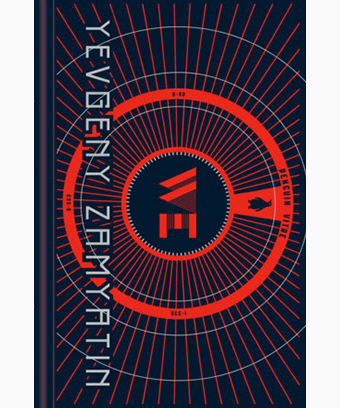
We by Evgeny Zamyatin (1920, E. P. Dutton, translated by Gregory Zilboorg, 1924)
Was the collapse of the Russian revolution into dictatorship the result of a long-standing Tsarist history or was it the product of the revolutionaries’ own political ideas? One of the merits of novels of authoritarian rule is their ability to probe competing theories. Yevgeny Zamyatin (1884-1937) had the distinction of being persecuted by both the Tsarist and Soviet regimes. His novel We (1920, trans. 1924) performed the remarkable feat of intuiting the subsequent history of the revolution at a time when Lenin was still alive, Trotsky had not yet been exiled, and a young People’s Commissar called Stalin was just beginning his rise to power.
Yet Zamyatin’s critique is broader, encompassing modernity in all its forms. He identifies a modern attitude about the mutability and perfectibility of human beings that was shared by a wide variety of political tendencies in the early 20th century. In We, Zamyatin sympathetically imagines a world where all the particular obstacles to the revolution have been overcome: it occurred many centuries in the past, technological development has liberated society from hunger, electricity is generated by the tides, citizens are brought up to believe the regime’s pronouncements, and its internal and external enemies have been completely defeated. These strong assumptions set up a test of the revolutionary idea itself. Society is ruled by a mysterious “benefactor” or “well-doer,” whose rule is approved unanimously each year by mass acclamation.
Our protagonist, D-503, is just one number among millions, but he is special: the First Builder of a spacecraft that will carry the revolution to other planets. Over the course of the novel, D-503 falls in love with I-330, a beautiful and dangerous revolutionary. He also begins to notice the world around him in a new way. The light of the sunrise and of the sunset have different characters, despite their mathematical symmetry. The faces of his counterparts have a distinct individuality, and every scene bursts with colors and smells which he has never noticed before. The square root of negative one begins to seem beautiful and mysterious, rather than simply impossible.
One of the most intriguing psychological aspects of the novel is that D-503 sincerely believes in the revolution. He views his awakening as a disease, and is frightened when the doctors tell him that he is unfortunately developing a soul, and that the development may be incurable. In a poignant passage he defends the revolution against the claim that it is simply a new type of monarchy, arguing that it is greatly superior because it resulted from a genuine desire to help people. “Instead of plus zero, we are at minus zero. Do you understand?…What does it matter if we are separated from the other black side of the zero…only by the thickness of a blade?” D-503’s awakening does not end well. He is eventually apprehended and effectively neutered in a most horrible way.
In an interview, Zamyatin said that “there are books of the same chemical composition as dynamite. The difference lies only in the fact that one stick of dynamite explodes once, but one book explodes thousands of times.” Zamyatin has the distinction of having influenced just about every twentieth century dystopia, from Orwell and Huxley to Vonnegut and Nabokov. Dynamite indeed.
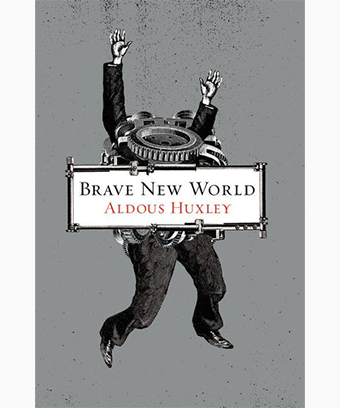
Brave New World by Aldous Huxley (1932, Doubleday)
In an early episode of The Twilight Zone, a jewel thief dies during a botched robbery and wakes up to find himself in a world where he succeeds at everything he tries. He assumes, naturally enough, that he is in heaven. Assisted by a jovial guardian angel, he amasses more money, power and companionship than he ever dreamed possible. Predictably, life soon loses its appeal, and he begs the guardian angel to let him leave heaven and go to “the other place.” The climax arrives when the guardian angel growls menacingly that “this is the other place.” Our utopias and dystopias share more than we might expect.
Whether or not Huxley read Zamyatin, his imagined future is quite similar, with an overlay of the commercial capitalism which Huxley–writing in the early years of the Depression–knew from both Britain and the United States. For Zamyatin, the inspired prophet of his social system was Frederick Winslow Taylor and his time-motion studies. For Huxley it appears to be the mass production of Henry Ford. In the World State of Brave New World, society is run by a small group of “World Controllers” who resemble Antonine emperors: remote, technocratic, and coldly utilitarian. Society is graded into classes, with a small number of Alphas and Betas permitted a moderate degree of freedom, and large numbers of genetically identical Gammas, Deltas and Epsilons to cheerfully do all the hard work. The parallel to the social order in Plato’s Republic, with its myth of the stratified metals, is pretty clear, but with a modern technocratic twist: the strata are socialized into acquiescence from birth by hypnopedia or sleep-teaching.
Some authoritarian regimes mobilize; others demobilize. Huxley’s dystopia clearly falls in the latter category. In a world where the state ensures perfect health and endless amusements in the forms of promiscuous sex, cabarets, high-tech sports, and a perfectly safe yet powerful drug—soma—to soothe anxieties, what need is there for politics anyway? Or Shakespeare—who is banned—for that matter.
Most people like it. Huxley’s protagonist Bernard Marx is only mildly disaffected. He tries to impress the woman he loves by taking her to a “savage reservation” in New Mexico, where they meet a young man, John, who has been brought up on Shakespeare. They take him back to London, where he becomes an instant sensation. Savage John, as he is known, becomes Huxley’s mouthpiece for criticizing the apparent paradise that he has conjured. John espouses the traditional, Victorian attitudes of Huxley’s youth as an alternative to utopian hedonism, and (somewhat ironically, given his passion for Shakespeare) is driven to despair and suicide by the immorality and decadence of his new environment.
Huxley’s central insight, and one that informs a whole strand of authoritarian fiction, is that the dictatorships of the future need not resemble those of the past. Given scientific advances, previous autocrats were mere amateurs. Real professionals will produce the citizens they require, rather than simply coercing the ones they happen to have. Huxley’s epigraph makes clear his disdain for utopianism of both the capitalist and communist variety, and his foreword to the 1946 edition argues that bureaucratic-managerial consolidation can easily take place under the veneer of democracy. But Brave New World questions the very idea of achieving social harmony through rational planning. Like Zamyatin, Huxley gives the social planner all possible advantages and still finds resistance at the end of the day.
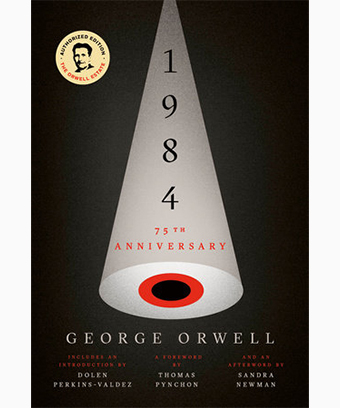
Nineteen Eighty-Four by George Orwell (1949, Secker & Warburg)
Thoughtcrime. The Two Minutes Hate. Telescreens. Newspeak. Memory holes. Big Brother. Has any other novel of authoritarian rule penetrated our consciousness so thoroughly? The tale of Winston Smith, “the last man in Europe,” proved so popular that even an unfriendly critic called it “an ideological superweapon.”
Both Zamyatin and Huxley had suggested that the hedonistic utopia which science makes possible might turn out to be undesirable. George Orwell’s Nineteen Eighty-Four suggests that if the state can produce and indoctrinate its own citizens, flying cars and soma will hardly be necessary. With the grim hand of the state in the background, even the best-placed citizens will be outwardly satisfied with a few mandatory party-sponsored activities like mass calisthenics and fundraising drives.
The novel relates the fate of Winston Smith, a party insider tasked with continually rewriting the news to fit the ideological moment; truth is malleable. He is not a prole but neither is he anywhere near the top of the pecking order. As in many dystopias, he is one of those incapable of buckling to the system; he keeps a diary, has a forbidden love affair and maintains a skeptical internal posture. Inevitably he is caught, tortured, and ultimately “corrected” by a shadowy Inner Party member called O’Brien. Like We, the story ends with a shattered and broken Winston declaring that “he loved Big Brother” and–more frightening–that 2 + 2 =5.
In our view, the novel has been persistently misunderstood. Despite his impeccable egalitarian and socialist credentials (see The Road to Wigan Pier and Homage to Catalonia), Orwell came to be seen as a kind of secular saint in capitalism’s grand struggle against communism. This would have amused the man who originated the term “Cold War,” but he made it quite clear that Nineteen Eighty-Four had a bigger game in mind. Like his high school French teacher Aldous Huxley, Orwell saw that new technologies had brought with them unsettling new values and ways of seeing the world, which had been taken up across the political spectrum.
Orwell used several terms for these developments, including “managerialism,” “neo-pessimism,” “realism,” and “power worship” But at the core of his deep unease was the tendency to treat politics, both national and international, as an arena exempt from ordinary moral standards. Nineteen Eighty-Four imagines these tendencies taken to the extreme. Orwell repeatedly referred to the novel as a satire, and his target was the unthinking acceptance of power politics by intellectuals of both left and right. He was particularly critical of the view, expressed among others by James Burnham, that democracy and other forms of popular government were ultimately shams concealing rule by managers, experts and administrators. Orwell wanted to show that the model was untenable on its own terms because it limited human action to the coldly amoral pursuit of power for its own sake. The world of Nineteen Eighty-Four is supposed to be at once chilling and ridiculous, a satire illustrating the inevitable outcome of assuming away what Orwell called “common decency.” Orwell argued that Burnham and other contemporary realists were reconciling themselves to totalitarianism by sketching a needlessly impoverished picture of human nature.
Life inside one of Burnham’s authoritarian superstates, according to Orwell, would not be quite so comfortable as D-503’s in We, nor would the “managers” be quite as obliging as Mustapha Mond in Brave New World. The shabby, dreary world of Nineteen Eighty-Four draws out the consequences of an impoverished, “realistic” view of what human beings are actually like. The Inner Party torturer O’Brien is a palpably absurd character, and his conversations with Winston exemplify Bertrand Russell’s argument that the will to power is ultimately a form of insanity. O’Brien’s Burnhamite vision of the future as “a boot stamping on a human face—forever” states the thesis of the pursuit of power for its own sake in its purest form. Although the novel ends with a broken Winston happily accepting the regime, in the appendix on Newspeak, Orwell describes Big Brother’s rule in the past tense. Nothing is inevitable, according to Orwell, unless we buy into cynicism.
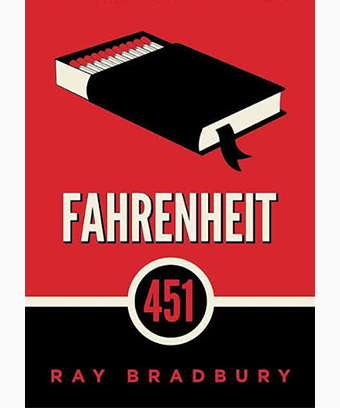
Fahrenheit 451 by Ray Bradbury (1951, 60th Anniversary Edition, Simon and Schuster 2013)
Bradbury’s Fahrenheit 451 is an early postwar American dystopia that was surprisingly prescient in its focus on information control. The book also had a particularly ironic history that resonates with its internal storyline. A 1967 edition designed for a classroom market retained the typesetting but changed the novel at more than a hundred points to smooth references to drinking, sex and nudity; it took over a decade for this dumbing down to get caught out and fixed.
The premise of book burning references the events of 1933 in Germany when the student union played a role in the campaign against un-German literature. Bradbury also acknowledges the influence of Koestler’s work, which we reviewed in our previous summer reading edition. But the critique is aimed as much at the authoritarian impulses in suburban culture as it is at the role of government.
Montag is a fireman, and the force is tasked with burning all books whenever they surface. Yet the precise political forces that sit atop the fire department are opaque and Bradbury locates the origin of the book ban in popular culture. The interaction of media and audience is the source of the problem. A dulled middle class is continually exposed to a futuristic TV that can occupy as many as four walls in a living room, pumping out mindless drivel. Writing is gradually reduced to banal summaries, Reader’s Digest style. In Bradbury’s account, reversion to this lowest common denominator is driven by an increasing aversion to stepping on minority toes. “Magazines became a nice blend of vanilla tapioca. Books, so the damned snobbish critics said, were dishwater.” Why bother with them at all?
But “it didn’t come from the Government down. There was no dictum, no declaration, no censorship to start with, no.” Rather a desire for homogeneity and resentment for readers who stood out was the Zeitgeist. The population would find happiness in sport and other diversions, some of them shockingly cruel. A society ground down to intellectual mush paved the way for the book ban, except for trade journals, comics and “three dimensional sex magazines.” Yet the fact that the book ban was demand-driven does not make it any less binding; enforcement through the fire department and robotic dogs is vicious.
A common trope in novels of authoritarian rule is the nail that refuses to be hammed down. The itch is partly for the forbidden per se. But ultimately books are appealing–at least to some–for what they have to say. Bradbury characterizes them as having texture or pores, but also erupting in emotion and feeling.
Another enduring trope in such dystopias is the resistance network that is fighting for alternative values. In Fahrenheit 451, each member of the rural underground memorizes—in effect becomes—a book. In doing so, each holds a promise for a different future. F451 is a period piece, written at the dawn of the nuclear era and including a devastating conflict. As in Nineteen Eighty-Four, we never really know what the war is about; we only know that several nuclear wars have been fought and cities–from which the resistance has escaped–have been destroyed. The burning of books and the burning of whole cities are loosely joined in the novel’s denouement, which is surprisingly hopeful about the prospects for rebirth.
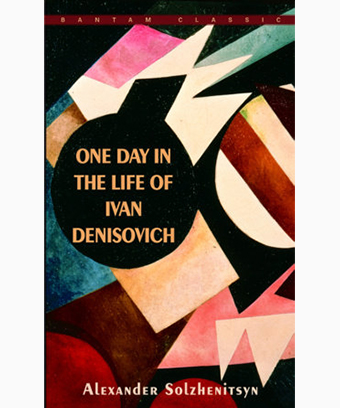
One Day in the Life of Ivan Denisovich by Aleksandr Solzhenitsyn (Novy Mir [1962], New American Library edition, 2009, trans. Ralph Parker)
If we were gauging novels of authoritarian rule by their direct political impact, the work of Alexander Solzenytsin would be at the top of the list. After the death of Stalin in 1953, Khrushchev freed over a million prisoners or “zeks” from the vast network of prison camps. He went on in his 1956 speech to the 20th Party Congress to denounce Stalin’s excesses. Believing he could control the historical narrative, Khrushchev allowed the publication of One Day in the Life in 1963. (In 2013, Dennis Kozlov pulled together an extraordinary collection of letters to Novy Mir detailing the varieties of both support and backlash against the novel).
Khrushchev was ousted in 1964, and the literary environment became much less forgiving under Brezhnev. Because of the need to guarantee the survival of the manuscripts to his next two novels—Cancer Ward and First Circle–Solzhenitsyn distributed partial copies and drafts which ultimately circulated in the so-called samizdat underground; not until decades later were full texts restored. Nonetheless, those two novels were ultimately published in the West in 1968, and on the basis of this trilogy he was awarded the Nobel Prize in 1970. If that were not enough of a public relations disaster for the Soviet regime, a similar tale of smuggled manuscripts ultimately resulted in the even larger bombshell of the first volume of the genre-bending Gulag Archipelago (in Russian in late 1972 and then in French and English in 1973).
If Gulag was the macrocosmic picture, combining Solzhenitsyn’s own memories of the camps with hundreds of testimonies, the trilogy of One Day in the Life, First Circle and Cancer Ward are the microcosm. All are set in highly-compressed periods, and built round granular autobiographical narratives, depicting his life of hard physical labor in the concentration camps (One Day), in a specialized scientific research unit (First Circle) and during his treatment for stomach cancer (Cancer Ward).
The first takeaway from One Day is simply that such brutal forms of slave labor existed. As Gulag was at great pains to make clear, the camps were hardly a relic of the Stalin era. Rather, they poisoned the Soviet Union from 1918, when Lenin and Trotsky initiated “reforms” of the legal system that set the gulag in place. Moreover, they continued in other manifestations under Brezhnev, most notably in the psychiatric “hospitals.”
Like all prison novels, One Day focuses on the complex social ecosystem of penal systems, with their sadistic and corrupt guards, trusties and hierarchy of alpha and beta inmates. Yet it is the extremity of the process and physical setting that permeates the book. At the front end, so to speak, is the opaque and ultimately absurd nature of how Ivan Denisovich Shukov is incarcerated in the first place: “According to his dossier, has been sentenced for high treason. He had testified to it himself. Yes, he had surrendered to the Germans with the intention of betraying his country and he’d returned from captivity to carry out a mission for German intelligence. What sort of mission neither Shukov nor the interrogator could say.” In fact, Ivan Denisovich had escaped from German captivity with several other soldiers and was arrested for no good reason.
Extreme, totalitarian regimes grind the individual down to a narrow environment, thereby limiting the likelihood of resistance. In the camps, daily life focuses entirely on the effort to cope with extreme cold and maximize food intake and sleep in the face of a completely unforgiving environment; it is a novel about a political system that reduces its inmates to slaves. The book is compelling for the detailed moves that can accompany something as banal as securing an adequate number of bowls of thin gruel for fellow squad members.
But survival is not just physical; it also has to do with retaining dignity and a sense of self. Solzhenitsyn devotes long passages to a discussion of a very specific masonry job that occupies a large part of this one day; the way that Ivan Denisovich views his task as something requiring attention, skills and standards. “At the spot he was working on, the wall had previously been laid by some mason who was either incompetent or stunk up the job. But now Shukhov tackled the wall as it was his own handiwork.”
Solzhenitsyn was embraced as if he were a liberal critic of the Soviet system, and at one level he was. But his critique was always more complicated, and in his infamous graduate speech at Harvard in 1978, he castigated the West for its political and cultural shallowness. In One Day in the Life, we see not only his damning critique of the entire Soviet system, but the hints of an alternative ideological frame. That frame is grounded partly in liberal values but also in a Russian variant of stoicism.
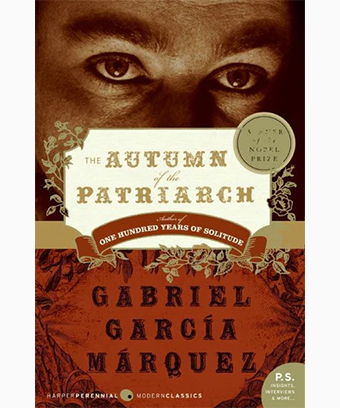
The Autumn of the Patriarch by Gabriel García Márquez (1975. Harper, trans. Gregory Rabassa 1976)
Pascal’s Pensees offers an incisive reflection on kings that speaks to a number of core themes in Garcia Marquez’s masterful dissection of tyranny. Kings should be enjoying their power, myriad material advantages, and exalted status. Yet they are no different than other mortals in facing existential anxieties, and in fact may be worse off. According to Pascal, they “will necessarily fall into forebodings of dangers, of revolutions which may not happen, and finally of death and inevitable disease.”
These psychological themes animate Autumn of the Patriarch, and are played out in extended interior monologues. The stream of consciousness narrative rings so true precisely because of the clutter of our own minds: random thoughts and memories; fixations, fantasies and desires. And like Pasal, Garcia Marquez focuses on the unnerving fact—the profound frustration–that even the extremes of earthly power do not solve for mortality. Death hangs heavy on nearly every page of Autumn, underlined by the chaotic environment of the presidential palace—with cows wandering through it—and the odors of decay.
However, the book is also embedded in a wider tradition of the caudillo novel and walks through the life-cycle of personalist rule; thus the Autumn in the title. Tracing a distinctive arc, the novel speaks both to traditional military dictators in Latin America and Spain—most notably Franco—but also to contemporary personalist dictatorships such as the Kim family in North Korea, or the Duvaliers and Assads in Haiti and Syria.
The book is decidedly non-linear but nonetheless broadly chronological in structure. In his youth, the patriarch—illiterate and from modest background–literally fought his way to power in wars that pitted centralizing federalists against liberals; the latter remain in the background as an ever-present opposition risk. Once in power, he goes through a populist phase. But a rational fear of his high-ranking generals, greed and personal entanglements with women combine to push his rule in a more violent and corrupt direction. The potential challenges emanating from even the staunchest loyalists in his high command is a continual preoccupation, with recurrent plots and purges as the result.
Corruption is also pervasive. In scenes reminiscent of the excesses of Imelda Marcos, his common law wife figures out how to exploit state power by raiding the markets and blithely telling traders to “send the bill to the government.” In another riveting story line, he figures out a way to rig the national lottery so that he always wins by employing orphan children. They appear to be blindly drawing a numbered ball from a sack, but the winning lottery ball has been frozen so they can detect it. To avoid his secret from escaping, the orphans are imprisoned and ultimately exiled.
Being situated in the Caribbean, foreign creditors and the United States are woven into the story line as imperialists who simultaneously keep dictators in office. In a wonderful bit of magical realism, the patriarch literally sells the sea around the island to the gringos, who carry it off to Arizona.
Another central theme in novels dealing with personalist authoritarianism is the role not only of whim and excess but of the potential of psychological decay and madness. The patriarch’s obsessions drive the narrative, and are reflected not only in random cruelties—including sexual ones—but in a broader collapse of the country’s fortunes. In a keen observation on the weight of dictatorship and how it shapes conceptions of time, the reign of the patriarch is portrayed as lasting well over a century. Pascal’s observations about mortality ultimately hold, as the patriarch is left with the recognition of all he has feared: “of commanding without power, of being exalted without glory, and of being obeyed without authority.”
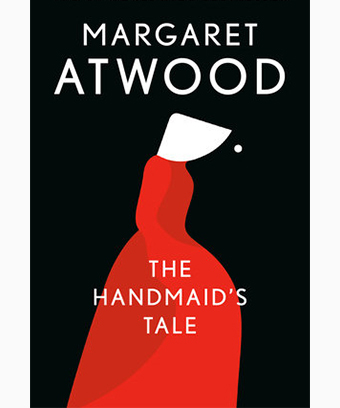
The Handmaid's Tale by Margaret Atwood (Houghton Mifflin 1986; Anchor Books 2017 with an Introduction by the author)
In her 2017 Introduction, Atwood talks about the array of influences on her book, from the Biblical story of Jacob, Rachel, Leah and their handmaids, to America’s Puritan foundations, to “group executions, sumptuary laws, book burnings, the Lebensborn program of the SS and the child-stealing of the Argentinian generals.” But the novel’s contribution to the genre of authoritarian fiction is clearly in joining a portrayal of autocratic rule with an extreme form of patriarchy in which women are reduced to breeders.
Atwood reflects on the challenge of writing a political dystopia: how to convince readers that the U.S. “had suffered a coup that had transformed an erstwhile liberal democracy into a literal-minded theocratic dictatorship.” She achieves this objective in part through a non-linear narrative. We never learn the real name of the protagonist, but under the dictatorship she is renamed Offred, as in of—and belonging to—Fred.
At the beginning of the novel, she is navigating an identifiable 1980s life in Cambridge as a librarian and young mother. In surprisingly short order, her effort to escape the country (to Atwood’s Canada) fails, she loses touch with both her husband and young daughter, and is serving the role of a Handmaiden: a potentially fertile woman put at the disposal of a Commander and his wife who sit at the elite apex of the regime. Yet that dystopian power structure is intelligible to us precisely because key elements of it are visible in our own patriarchal power structures; the novel is never entirely foreign terrain.
The origins of the so-called Gilead regime are shadowy, but the broad pattern is plausible to students of authoritarian rule. Blaming Islamic fanatics, a religious army assassinates the President, machine-guns Congress and declares a temporary state of emergency that quickly prolongs. Looming in the background is a religious civil war around gender, with a deeper backdrop of collapsing fertility that Atwood links with a string of environmental catastrophes. With the risk of extinction, women are both prized and protected but simultaneously controlled for natalist social purposes.
Atwood is masterful at tapping into the multiple nodes of power. In one of the first acts of the new government, all women’s access to their bank accounts are frozen. Power relations almost instantly shift, even with her perfectly liberal husband.
One thing quickly becomes clear: the battle lines by no means cleave along gender alone. The new order is clearly patriarchal but is enforced by a complex coalition of older Aunties, infertile wives, and zealots among the Handmaidens themselves. The plotline of the book is absorbed by Offred’s efforts to negotiate an extraordinarily repressive social system which nonetheless has the expected cracks in it: Handmaidens share information, there is corruption and black markets and the behavior of elites is deeply hypocritical.
Yet resistance in such regimes is associated with risk; Atwood pulls no punches on the gory and public extremes to which Gilead is willing to go, including in a shadowy world of environmentally-dystopic Colonies to which dissenters can be exiled. Every relationship is fraught as a result. Is the Handmaiden with whom I am paired for daily shopping chores a true believer, just willing to reminisce about the past, or tied to the resistance? How far is the Commander with whom I am forced to breed willing to bend rules? What sexual risks am I willing to take?
The questions, unfortunately, cut deeper because if resistance is costly then it is hard to avoid acquiescence. Or worse. Offred’s story is paired with a friend from the pre-Gilead era who makes altogether different choices. She intersects with women who have become completely socialized to their own passivity, and Atwood tackles the myriad of compromises forced on Offred; indeed, they are at the heart of the novel’s narrative.
The Handmaid’s Tale owes its name to Chaucer and is subsequently revealed as a kind of historical document, which both deepens and complicates our understanding of the story. In 2019, Atwood published a sequel in The Testaments that we will review in a subsequent post. There can be little question, though, that Atwood provides us one of the most profound accounts not only of gender and autocracy but of the individual and social psychology of living under dictatorship.
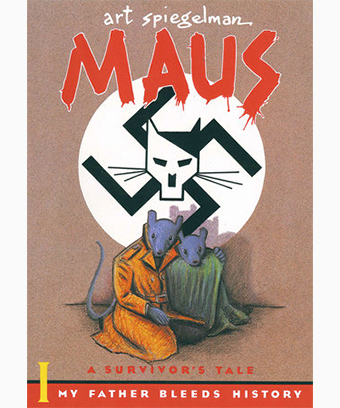
Maus: A Survivor’s Tale by Art Spiegelman (Pantheon, 1991)
Spiegelman protested the inclusion of Maus on the New York Times fiction best-seller list. He noted that he “might have lopped several years off of the thirteen I devoted to my two-volume project if I could have taken the novelist’s license while searching for a novelist’s structure.” Yet much of the historical fiction we consider blurs that line, too. And Maus is one of the more compelling accounts not only of Nazi rule but the consequences of treating minorities as fundamentally different than the rest of us.
Spiegelman’s graphic novel is a frame story with two interlinked narratives. The first is Spiegelman’s effort starting in the late-1970s to write the book we are holding, and the complex and combative relationship he has with his Holocaust survivor father Vladek. But the second is Vladek’s extraordinary tale of survival in the ghettos and death camps of occupied Poland. In combination, the novel not only captures the trauma of the camps but how that trauma is passed down across generations.
The epigraph of the first volume quotes Hitler as noting that “the Jews are undeniably a race. But they are not human.” The Nazis are thus positioned in a long tradition of autocratic regimes that are based in part on persecution of minorities, with a clear corollary: the more foreign–even alien or inhuman–the minority group, the broader the permission to root them out by whatever means necessary. Spiegelman captures this dynamic by portraying the Jews as mice, the non-Jewish Poles as (often complicitous) pigs and the German Nazis as cats. Once those fundamental distinctions are made, anything becomes possible.
The setting is Poland, particularly following the onset of war in August 1939. Germany incorporated part of Poland directly into the Reich; Vladek’s town—Sosnowiec—fell in that zone while the remainder of the German conquest, the Protectorate—was effectively a colony. What we witness in compressed time is the gradual, then accelerating, dispossession of the Polish Jews: first, the permission to abuse them and the expropriation of property; then forced labor and the creation of the ghettos; finally the movement—late into the war, when all was clearly lost—to the death camps. And Vladek’s story reminds us that the death camps were not just about the gas chambers; equally if not more horrific was the organized machinery working prisoners to death.
Maus is extraordinarily rich, weaving together Vladek’s love for his wife Anja, their family tragedies, and close observation of how the organized Jewish communities in Poland sought to manage the deadly risks to which they were exposed. A central theme is the radical contingency that accompanies these extreme forms of human degradation. Vladek is endlessly resourceful, but death in radical authoritarian regimes is near random. Get in the wrong line during a selection, and you are off to the gas chambers.
The book is made personal by Spiegelman’s effort to come to grips with his father’s life. In an exchange with his therapist, he ponders his admiration for his father’s extraordinary survival instinct. His life seems trivial next to the suffering of this father’s generation. But does that mean that those who did not survive—whose stories we don’t have—were somehow deserving of their fate? This is just one of the many questions the descendants of survivors–in some ways all of us–must grapple with.
Matthew Draper is a Ph.D. candidate in the department of political science at UC San Diego, and incoming assistant professor of political science at Dickinson College. Stephan Haggard is distinguished research professor at the UC San Diego School of Global Policy and Strategy and research director for Democracy and Global Governance at IGCC.

Global Policy At A Glance
Global Policy At A Glance is IGCC’s blog, which brings research from our network of scholars to engaged audiences outside of academia.
Read More