Current History Celebrates a New Editorial Era at Washington, D.C. Relaunch
As the sun set over Washington, D.C. on October 21, 2026, a lively crowd of scholars, policy experts, journalists, and writers gathered to celebrate a new era of Current History, the longest continuously published magazine of global affairs in the United States.
Hosted by the UC Institute on Global Conflict and Cooperation (IGCC), the rooftop reception brought together leading voices from academia, policy, advocacy, government, and the media, alongside longtime contributors and former editors, to celebrate the magazine’s distinguished past and look ahead to the future.
Begun as a supplement to The New York Times in 1914, Current History has published a thrillingly diverse range of writers, world leaders, and scholars, from W. E. B. Du Bois, Susan Strange, and George Bernard Shaw, to Sheila Jasanoff, Anirudh Krishna, Joseph Stiglitz, Francis Fukuyama, Javier Auyero, and Mlada Bukovansky, among others.
The Washington gathering reflected both the depth of that legacy and the enthusiasm surrounding the magazine’s next chapter. Among those attending was former editor Bill Finan, who led Current History from 1991 – 2006. The occasion offered an opportunity to reconnect old colleagues, forge new relationships, and invite a new generation of thinkers into the magazine’s pages.
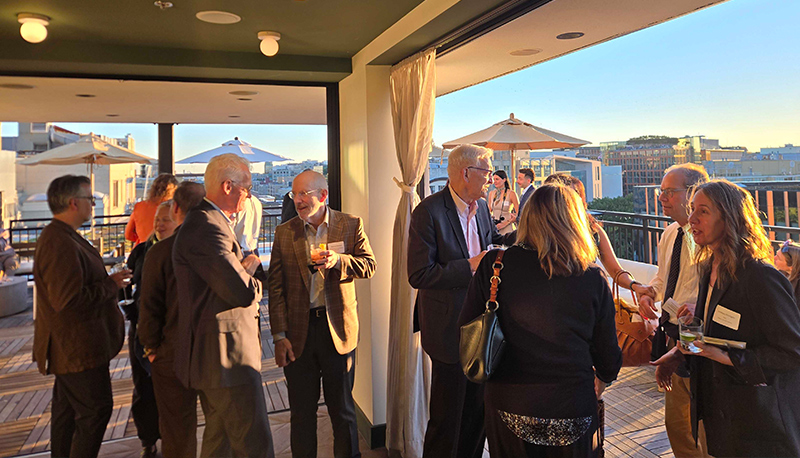
Attendees gather at the Current History re-launch event in Washington, D.C. on October 21, 2026.
In her opening remarks, Current History editor and IGCC associate director Lindsay Shingler reflected on the publication’s role in a world marked by profound change, geopolitical uncertainty, and an increasingly crowded and fast-moving media landscape.
She described an editorial vision centered on:
“…writing that deepens and widens our perspectives about the world; writing that grapples openly with the complexities and ambiguities of our age; writing that is both intellectually demanding and also a delight to read; writing that meets the moment and is maybe even courageous.”
Shingler was joined by Current History senior editor and IGCC research director Stephan Haggard. Together, they emphasized the importance of rigorous, accessible analysis that draws on deep expertise without losing sight of the human dimensions of global affairs. They were joined by past and present contributors Thea Lee, an economist who served as the Deputy Undersecretary for International Labor Affairs at the Department of Labor from 2021 to 2025; president of the Economic Policy Institute; and advocate for the AFL-CIO (read her seminal essay on trade in a 1996 issue of Current History), and Charlie Kupchan, a senior fellow at the Council on Foreign Relations and professor of international affairs at Georgetown University, who served on the National Security Council during the Clinton and Obama administrations (read his essay on Europe and American in the Middle East from a 2007 issue). Lee and Kupchan shared their reflections on the past and present of the magazine.
Published every other month, Current History will continue to examine major questions in international politics, economics, and society—from trade and migration to conflict and geopolitical change. Under new editorial leadership, the magazine also aims to create space for more reflective writing and to open its pages to a wider array of contributors. Said Shingler: “We believe that setting down a meaningful account of history-in-the-making requires a range of perspectives, and so a shift will be to open our pages, not only to scholars, but also to practitioners, leaders, journalists, writers and creatives.”
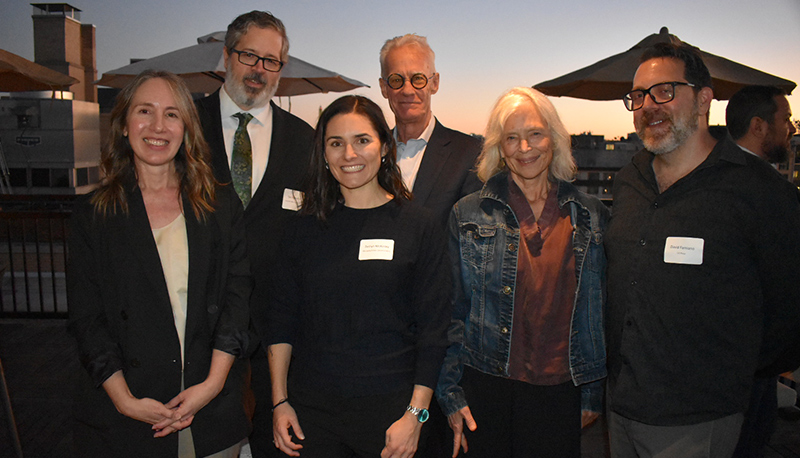
The Current History team (L to R): editor Lindsay Shingler, associate editor Daniel Kennelly, managing editor Zethyn McKinley, senior editor Stephan Haggard, artist Cate Whittemore, and UC Press journals editor David Famiano.
The celebration was held at a venue overlooking 16th Street at Scott Circle, just minutes away from IGCC’s Washington, D.C. office at the UC Washington Center. It also brought together the team shaping the magazine’s new chapter, including UC Press journals editor David Famiano, managing editor Zethyn McKinley, associate editor Daniel Kennelly, and artist Cate Whittemore, whose striking artwork appears on the cover of each issue.
IGCC’s first issue of Current History was released in July 2026, and the November issue is now available online. With a new editorial home, a distinguished intellectual inheritance, and an ambitious vision for the future, Current History is poised to remain an essential forum for understanding the forces reshaping the world.
To explore the latest issue and learn more about the partnership, visit the Current History page on our website.