Novels on Authoritarian Rule III
In this third entry in our series reviewing books of fiction on authoritarian rule, we review an early postwar entry by Vladimir Nabokov, a classic American dystopia in which Germany and Japan prevail in World War II, a personal story from a lightly fictionalized Albania under Hoxha, an account of the German commander at Auschwitz, and a technological dystopia that is eerily akin to the world we actually live in.
Prior reviews of fiction can be found here and here. A review of academic and policy-oriented work can be found here.
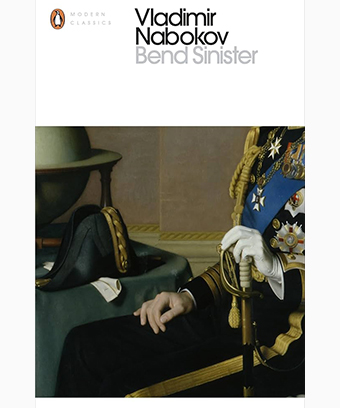
Bend Sinister by Vladimir Nabokov (Vintage, 1947)
In 1961, Nabokov wrote an introduction to his 1947 novel Bend Sinister, his first written in the United States. In it, he takes the strange step of distancing himself from the themes of autocratic rule that frame the story. He claimed to be “supremely indifferent” to contemporaneous political issues and argued that “automatic comparisons between Bend Sinister and Kafka’s creations or Orwell’s cliches would go merely to prove that the automaton could not have read either the great German writer or the mediocre English one.” Yet on the next page, he acknowledges precisely the context in which the book was written: the “idiotic and despicable regimes…: worlds of tyranny and torture, of Fascists and Bolshevism, of Philistine thinkers and jack-booted baboons.”
Take me as an automaton, but Bend Sinister plays around with one recurrent theme in fiction on authoritarian rule: the mistaken belief in personal immunity from the dictator’s reach and the shock of realizing the miscalculation. Adam Krug is portrayed as the preeminent philosopher and public intellectual of his fictional country, which he identifies in his introduction as Slavic and Germanic (with ample wordplay in an invented language). Through the first half of the novel, Nabokov paints the gradual rise of an ideological movement (Ekwilism), a caricaturized state socialism of the Stalinist sort. One of Krug’s classmates in school—Paduk—is smitten with these ideas. Paduk had been universally disliked, and bullied by Krug, but his Average Man Party, based on the idea of absolute social homogeneity, gains steam and all the trappings of dictatorship start to fall into place.
The drama starts with Krug’s university colleagues beseeching him to step up and use his international and domestic prestige to protect the university by reading a speech they have crafted. He is supremely indifferent. But before long, it is Krug himself who comes under pressure from the dictatorship to get in line and show that the intellectuals are on board with the new regime; Paduk, too, has his prepackaged speech. Nabokov claims in his introduction that the book is really about Krug’s relationship with his son in the wake of his wife’s death. It turns out, however, that his son is “the handle” as Paduk puts it, the point of leverage he thinks he can use to get Krug on side. Krug ponders exile, but his blundering self-importance gets in the way and the novel devolves into a tragic denouement.
The novel being Nabokov, it is packed with literary allusions; one particularly interesting chapter digresses into how a regime loyalist would translate Shakespeare in a way that is consonant with regime interests and—needless to say—completely at odds with Shakespeare’s. And Nabokov is right that the novel is grounded in a network of Krug’s social relations and family as well as Krug’s own psychological pretensions and blinders. However that is precisely the dimension that good novels on autocratic rule bring to the table: how the fundamentally human is put at odds with the ambitions of dictators and their opportunistic and thuggish minions. It in no way detracts from the novel to situate it in the early postwar moment, when reflection on dictatorship was very much in the air.
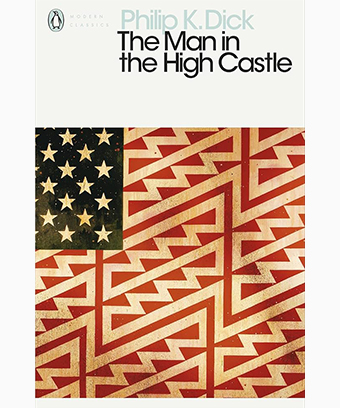
The Man in the High Castle by Philip K. Dick (Mariner, 2011 [1962])
Philip K. Dick’s The Man in the High Castle (1962) depicts an “alternative present” in which the Allies have lost World War II and the United States is partitioned between German and Japanese occupiers, with a neutral buffer in the Rocky Mountain States. The novel thus draws attention to a particular form of authoritarian rule: that imposed by an outside power. Succession politics in Berlin, inter-imperial rivalries, and the continued horrors of Nazism constitute an important backdrop to the dramatic narrative. Baynes, a German spy opposed to the excesses of his own government, locates those horrors in a proclivity for abstractions. “Not a man here, a child there, but an abstraction: race, land, Volk…the abstract is real, the actual is invisible to them.”
The story line rotates precisely around that overlooked world of individual moral choices—to resist or not—and their highly contingent effects. Dick’s Japanese Pacific States is so firmly under the physical, economic, and cultural control of Japan that profound changes have taken place in the self-understanding of ordinary citizens. Their language changes, taking on some of the morphological characteristics of Japanese. Their values begin to change, tinged with what Dick sees as characteristically (or stereotyped) Japanese elements.
Ultimately, the self-images of both rulers and conquered Americans begins to change. One of Dick’s five central characters, the antique dealer Robert Childan, comes to see himself as impossibly boorish and uncultivated compared to his urbane Japanese clients, buying into the propagated Japanese and German imperial narratives so enthusiastically that he outdoes even the occupiers themselves. Frank Fink—another core character—comes to doubt his own artistic impulses but turns his considerable skills to making fake American antiques for sale to Japanese collectors. His resistance manifests itself in a return to the aesthetic value of his folk art.
Dick unites several of his main characters through the I Ching or Book of Changes, which they consult for guidance; these readings are all moments of reflection on highly contingent choices. The most keenly developed character in the book is the head of Japan’s official trade delegation to its colony, Tagomi Nobusuke. Deeply reflective and troubled, Tagomi continually grapples with his imperial role and the excesses of the Nazi allies. As with several of the American characters, he ultimately veers into resistance, sacrificing his career and competing principles of obedience in order to save an innocent life.
The book is considered a science fiction classic because of its complicated and warped sense of time. One recurrent theme in the book is a novel—The Grasshopper Lies Heavy—which imagines a version of history in which the Allies do in fact prevail (in the Netflix series, the underground novel is replaced by a similar film). Its author Hawthorne Abendsen is the man in the high castle. His novel is a ray of hope for an alternative political world. The book and Abendsen’s very existence is itself a component of the resistance and motivates one of the main characters, Juliana Fink, to action. But which world are we actually in? The reader of Man in the High Castle naturally assumes that the setting of the book is—well—the setting of the book: the Japanese Pacific States. But what if the story in The Grasshopper Lies Heavy is the actual world, and The Man in the High Castle is the imagined dystopian alternative?
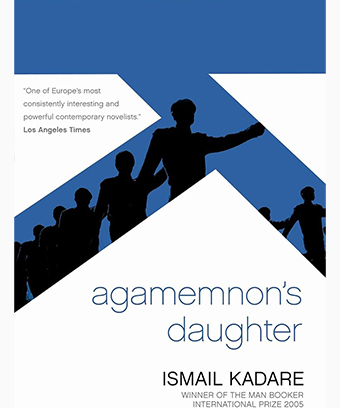
Agamemnon’s Daughter: A Novella & Stories by Ismail Kadare (Arcade, 2006)
Kadare’s novella captures the deep, pervasive corruption of civil society that takes place under authoritarian rule, where concentrated political power conditions ostensibly nonpolitical relationships. Kadare describes a society much like our own, where citizens have jobs, friends, and lovers, hopes, dreams, and fears. However, each of these relationships is warped by the implacable hand of the state. In the bright cool of an early-May morning in Tirana, Kadare’s protagonist shows us how a lightly fictionalized version of the Hoxha dictatorship poisons Albanian life through and through.
Kadare’s narrator is passionately in love with Suzana, the daughter of a high regime official who has recently been promoted. That love is reciprocated. But as the book opens, Suzana tearfully informs the narrator that on her father’s instruction she must break things off. In the wake of this shock, Kadare’s protagonist attends a compulsory state parade. Because of his romantic connection, he has secured an invitation that places him among the politically connected in the viewing stand. As he walks through the layers of security, he ascends closer and closer to the political inner sanctum, meeting along the way a clutch of characters that he has encountered through his career. Many fall lower on the political hierarchy, however, triggering memories of those who had fallen yet deeper into the purgatory of internal exile.
His possession of an exclusive invitation elicits cynical inquiry along the way: “So what did you do to earn the invitation, eh?…You played at being a little hero as long as you could, didn’t you, but in the end you realized that there is no other way.” He looks enviously at an acquaintance, a famous painter, who by dint of his appeal abroad has earned “the right to scowl in public.” Just like everyone else, our narrator begins to wonder, “What had he paid for such immunity?”
The central social problem of the dictatorship in Kadare’s view is that the option of denouncing others as ideological enemies of the state creates an environment where interpersonal trust is impossible. As Kadare’s narrator explains, “the first person to entertain suspicion wins the match. The suspected person, despite probably being innocent, is always on the defensive simply from having been slow off the mark.” The very real necessity of self-preservation requires each to sacrifice others in order to maintain position, to “tear out living flesh so as not to fall to the bottom of a pit, with no means of climbing back up.” And compromising in this way only contributes to the atrophy of the moral norms that sustain civilized life. “It was a truly diabolical mechanism, because once you’ve debased yourself, it’s easy to sully everything around you. Every day, every hour which passed stripped more flesh from moral values.”
The narrator comes to reflect on his severed relationship with Suzana in the context of sacrifice. He ponders why her father’s political ascent requires her to give up the man she loves, ultimately drawing an analogy with the infamous sacrifice of Iphigenia by Agamemnon. While Euripides tells us that Agamemnon was willing to sacrifice his daughter to obtain favorable winds for the voyage to Troy, Kadare’s narrator reinterprets Agamemnon as an authoritarian ruler who seeks to increase his own political control. Drawing on an analogous sacrifice by Stalin of his captured son during the war, Kadare’s narrator comes to the conclusion that authoritarian rulers sacrifice members of their own families—and societies—not to any noble purpose but simply to demand more from their populations; both Kim Jong Un and Nicolás Maduro immediately come to mind. The demand for sacrifice becomes a means of consolidating authoritarian rule. And why would a dictator want to “reduce life to such a stony waste?…Only because, when life is withered and stunted, it is easier to control.”
Kadare convincingly shows how tyranny can make genuine friendship impossible; the citizen of an autocracy necessarily faces the world alone. In the loneliness of one man’s walk through a crowded street, Kadare lays bare the emotional poverty of authoritarian rule.
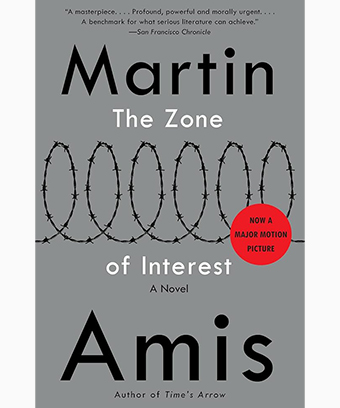
The Zone of Interest by Martin Amis (Penguin, 2014)
Like Nabokov’s later preface to Bend Sinister, Amis includes an epilogue to Zone of Interest dealing with his thinking and process. Its central theme is the inexplicability of the Holocaust. Outlining his historical research on the final solution, Amis notes that “while I might have gained in knowledge, I had gained nothing at all in penetration.” Yet he describes how this inexplicability—the mystery—allowed him to turn his gaze from the victims to the perpetrators. In doing so, he brushes up against the debate sparked by Hannah Arendt’s Eichmann in Jerusalem. Amis’s exploration of the viewpoint of the perpetrators—both willing and opportunistic—veers into satire and raises the question of whether such a viewpoint enlightens or trivializes (publishers in both France and Germany initially refused the book). Or is the casual thoughtlessness that Arendt identifies in Eichmann—that he was a “clown” rather than a “monster”—precisely the reason why authoritarian regimes can spiral into crimes against humanity?
The “zone of interest” refers to an area surrounding Auschwitz, where thousands of SS worked during the five years the camp was in existence; the book traces a period from the swift victories in France to the shadow of likely defeat on the Eastern front. A core conceit of the book is in the tension between the horrific mechanics of mass killing and the quotidian lives of the SS elites and their wives and families; this theme is even more front and center in the 2023 film by Jonathan Glazer.
The narrative rotates around three characters, each representing a type. Szmul Zacharias is the Polish leader of the Sonderkommando, a unit of Jewish prisoners forced into the dirty work of gathering and disposing of bodies. He is Amis’s voice of conscience, justifying his existence by efforts to save the few lives he can, record notes, and thus bear witness once he, too, is murdered.
Of greater interest to our purposes here are two types of perpetrators. Paul Doll, the camp commander, is a veteran of World War I and a blustering drunk who is preoccupied with the challenges of carrying out his mission: unloading trains, making the “selection” of those who might be of use, and dealing with the shifting technologies of death. He is also a true believer and the voice for Nazi propaganda. Yet is he really as thoughtless as Arendt’s Eichmann purportedly was? As Doll acknowledges in a moment of self-reflection, “disposing of the young and elderly requires other strengths and virtues: fanaticism, radicalism, severity, implacability, hardness, iciness, mercilessness….” But this moral inversion only makes sense if you buy the assumptions of anti-Semitism and that the Jews would do the same if the opportunity arose. With this shift in moral view, killing efficiently is nothing more than duty. As Doll muses to himself, “the Christian system of right and wrong, of good and bad, is one we categorically reject. Such values—relics of medieval barbarism—no longer apply. There are only positive outcomes and negative outcomes.”
Equally if not more repugnant are those who go along—and admit that they are doing so. “Golo” Thomsen is connected through family to Hitler’s private secretary, Martin Bormann, and heads a massive factory in the zone whose managers are more preoccupied with securing cheap labor than delivering body counts (he is also a relentless womanizer who is attracted to the commandant’s wife: that triangle, and Hannah’s memory of a past socialist lover, animate the narrative). Even though the novel suggests that Golo was a foot dragger who took small steps to sabotage the military industrial complex, in the end he is more self-consciously complicit than Doll. He reflects on Hitler as a “known political killer who, when he spoke in public, often foamed at the mouth, a man almost visibly coated in blood and mire.” Nonetheless, as the “gross mockery settled on the lives of all but the mad: emotion, sensibility and delicacy retreated from me, and I developed the habit of saying to myself ‘Let it go Let it go.’”
Neither of us loved this book, and we were not alone; critical reception was decidedly mixed. But even in its failures, it raises the question of how to meaningfully approach the extremes of the authoritarian form: those that are perpetrators of genocide.
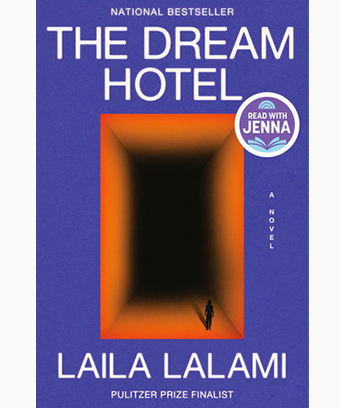
The Dream Hotel by Laila Lalami (Pantheon, 2025)
In sorting through novels of autocratic rule, we found what might be called near and distant dystopias. Distant dystopias portrayed worlds that were far from ours in some fundamental way, but nonetheless touched core issues; in future posts we will consider some compelling science fiction. Near dystopias are scarier, because they look so much like the real world, in Laila Lalami’s The Dream Hotel eerily so. She captures a near future—and present—in which the law, technology, and opportunistic companies combine in a surveillance state that can err in quite obvious ways.
Sara Hussein, a digital archivist at the Getty Museum, is detained at LAX on her return from a conference in London. She is stopped because of a red flag raised by a faceless algorithm.
The political backdrop is crisis. A mass shooting at the Super Bowl halftime show twenty years prior to the story killed 86 on live television. The perpetrator was a lone wolf, but as with many mass shooters one who left ample clues of distress. Republicans seized on the moment to pass an omnibus Crime Prevention Act, which established a Risk Assessment Administration (RAA). As in the classic Spielberg film Minority Report (based on a short novel by Philip Dick), the task of the RAA was not to find criminals and punish them after the fact but rather to identify risky individuals in advance of their crimes. The RAA enjoys majority support and has cut crime by nearly 50 percent.
The dystopian elements of the novel do not arise solely from an overweening state, but from the complex of companies the government subcontracts for its data analytics and detention facilities. One of these sources is Sara’s “neuroprosthetic,” an implant from Dreamsaver Inc. that manages sleep deprivation but also allows corporate access to her dreams. The algorithm that flagged Sara at LAX is opaque for legal as well as technological reasons—as proprietary software—but the information gleaned touches on the most deeply personal and idiosyncratic features of her mental life, from marriage and sex to family resentments.
The narrative rotates around Sara’s efforts to get out of the facility in which she is not detained but “retained”; the novel captures well the euphemisms of autocratic rule. She faces the challenges of being a wife and mother while incarcerated and the bonds—and rivalries—among the diverse women in detention. The legal and penal systems are riddled with catch-22s, such as the inability to access why the algorithm flagged you in the first place to the well-known Kafkaesque trope of how legal processes jam up into closed loops and maddening delays. Yet one of the most compelling reflections comes in a discussion of how the boundaries of what constitutes crime are constantly being redefined, and as Sara puts it, “I have done nothing wrong…it’s only that the line of legality has moved, and I am now on the wrong side of it.”
Lalami struggled to figure out Sara’s exit and the ending is not altogether satisfactory. But the route does involve both individual and collective resistance. Contrary to expectations, resistance proves effective in this case and produces an enduring sense of solidarity among some of the women who passed through what is in effect a prison camp. But in this case, the personal outcome is less compelling than the interwoven picture Lalami paints of a contemporary dystopia. Lalami’s world is one in which crime is a pretext for an expansion of state policing and penal power, aided by technologies and companies intent on invading privacy and substituting passing thoughts and dreams for criminal action.
Matthew Draper is a Ph.D. candidate in the department of political science at UC San Diego, and incoming assistant professor of political science at Dickinson College. Stephan Haggard is distinguished research professor at the UC San Diego School of Global Policy and Strategy and research director for Democracy and Global Governance at IGCC.

Global Policy At A Glance
Global Policy At A Glance is IGCC’s blog, which brings research from our network of scholars to engaged audiences outside of academia.
Read More