Rival Blocs?: The Future of Northeast Asian Security
September 03, 2026
Lindsay Shingler

We flew into Incheon in the midafternoon through a thick gray sky. Outside, the July air was dense and warm—enveloping. From the airport shuttle, I got my first glimpse of South Korea: lush green hills topped with still tufts of clouds. A horizon punctuated with islands of high-rises that looked like mirages out in the distance, impossibly dense columns rising up into the sky like Tetris grids.
The Seoul metropolitan area is home to more than half of the country’s population. Downtown is a bustling cityscape of hotels, banks, government buildings, corporate offices, ancient temples, department stores, historic monuments, flashing advertisements, double decker buses, and crowded sidewalks. It’s a place that has captured the imagination of the West. South Korean film and television have flooded American streaming services, and its food and beauty products are ubiquitous on social media. In the days before departure, I read articles about the rise of medical tourism to South Korea among Americans, and the return of K-pop sensation BTS, who are back on tour after compulsory military service and selling out stadiums once again.
South Korea is a rising cultural and economic power, a place of energy and vitality. Which makes it all the more jarring, as we drive up to our hotel, to realize that North Korean missiles, rockets, and artillery with the power to blast Seoul into eternity are only 35 miles away.
* * *
North Korea is not the isolated nation it once was, bunkered in a remote corner of the global stage. Its economy reportedly grew by 3.7 percent in 2024, according to The Wall Street Journal, alongside an increasingly cozy military alliance with Russia. And with a cache of nuclear weapons, the country’s leadership is feeling confident. In March, North Korean leader Kim Jong Un declared South Korea a “hostile state” and removed references to unification and ethnic unity from the country’s revised constitution—a major policy shift that has ratcheted up tensions along an already tense border.
More than three decades ago, an effort began to try to avoid just this scenario—that is, to try to prevent North Korea from acquiring nuclear weapons and to foster peace and cooperation among the major global powers and players in Northeast Asia. After the Cold War ended, there was a dearth of diplomatic channels for the major countries in the region to talk. In 1993, Susan Shirk, the director of a research institute based in Southern California, formed NEACD—the Northeast Asia Cooperation Dialogue—and invited scholars and government officials from China, Japan, Russia, South and North Korea, and the United States to attend. Known as a Track 1.5 dialogue for its mixture of academics and government officials acting in an unofficial capacity, NEACD is said to have formed the basis for the Six Party Talks on North Korea’s nuclear program that met between 2003 and 2009.
Now, almost 35 years later, the research institute Shirk led—the University of California Institute on Global Conflict and Cooperation (IGCC)—continues to host the gatherings annually. And NEACD’s founding goals seem more important than ever.
* * *
The 34th meeting of NEACD was held July 23 through 24 at the Plaza Hotel in downtown Seoul. It convened dozens of academics and government officials from the NEACD countries, minus North Korea, which hasn’t participated since 2009. A smaller group of defense experts met on July 22 for the Defense Information Sharing (DIS) meeting, which formed in 1997 as an accompaniment to NEACD, focused squarely on dialogue among military officials.
It is difficult to identify another region of the world where so many drivers of global politics, economics, and security converge. Northeast Asia is home to three nuclear-armed states, two major U.S. allies with significant military capabilities, and tens of thousands of U.S. troops. It’s the economic engine of the world, dominating production of such essentials as semiconductors, ships, and automobiles. And it is home to the world’s second-largest economy (China), and the site of the central flashpoint—Taiwan—that could tip China and the United States into war.
Northeast Asia is the stage where a slow-motion drama of historical transformations is playing out. On the one hand is the rise of China, North Korea’s maturation as a nuclear weapons state, and Russia’s increasing reliance on China and North Korea and isolation from much of the West. On the other is increasing cooperation between the United States, Japan and Korea, but also uncertainty about the future of U.S. primacy, Japan’s gradual departure from decades of military restraint, and the consequences of U.S. trade policy for the future of technology, trade, and industrial policy.
Questions about alliances, U.S.-China competition, economic security, the implications of the U.S.-Israel war against Iran, and the growing dangers of nuclear proliferation and menace of North Korea animated discussions across all three days. Debates continued during lunches and over long dinners of Korean barbecue and beer that lingered well into the evening.
And yet despite the tectonic shifts unfolding around the globe, in many ways, the dynamics that characterized NEACD’s early years haven’t so much changed as persisted and deepened. In a policy paper published in 1994 alongside one of the earliest NEACD meetings, Choi Kang (who still attends NEACD) and Cha Young-Koo, wrote: “We are living in an era of intriguing contradictions: power among nations is increasingly diffuse, yet nations are more interdependent than ever; ancient rivalries are being played out by small and medium powers, yet with all of the destructive potential of modern weaponry.”
It’s a world that sounds very much like our own world today.
* * *
The DIS meeting was held at the Asan Institute for Policy Studies, a think tank tucked away in a leafy neighborhood in the Jongno District of Seoul, near Gyeonghuigung Palace. U.S. grand strategy in the Indo-Pacific has traditionally rested on its network of alliances, and these new moves by the Trump administration are leading to fears, expressed throughout DIS and NEACD, that the United States may retreat from Northeast Asia.
Alliances—their composition, trajectory, drivers, and impacts on peace and security—were a central theme running throughout the entire week. There was wide agreement that these commitments are shifting and hardening in ways that are dynamic and dangerous. A chief concern is that relations between China, Russia, and North Korea may be solidifying into an authoritarian bloc that could challenge the interests of the democratic United States, Korea, and Japan. Russia and North Korea signed a “Comprehensive Strategic Partnership” treaty in 2024 that promises mutual military assistance, and North Korean troops and munitions have supported Russia’s war in Ukraine in return for money, diplomatic protection and, potentially, military technology. The political dividend for Pyongyang has been significant: Moscow has reduced North Korea’s isolation, treated Kim as a valued strategic partner, and used its Security Council veto to cripple UN monitoring of sanctions that Russia itself once supported. The growing pact also shows the power of a European war to alter the balance of power in an entirely other part of the world. North Korea is not only gaining economically from the new partnership with Russia, but is learning potentially valuable lessons about the new types of warfare that the Ukraine war is revealing on a daily basis.
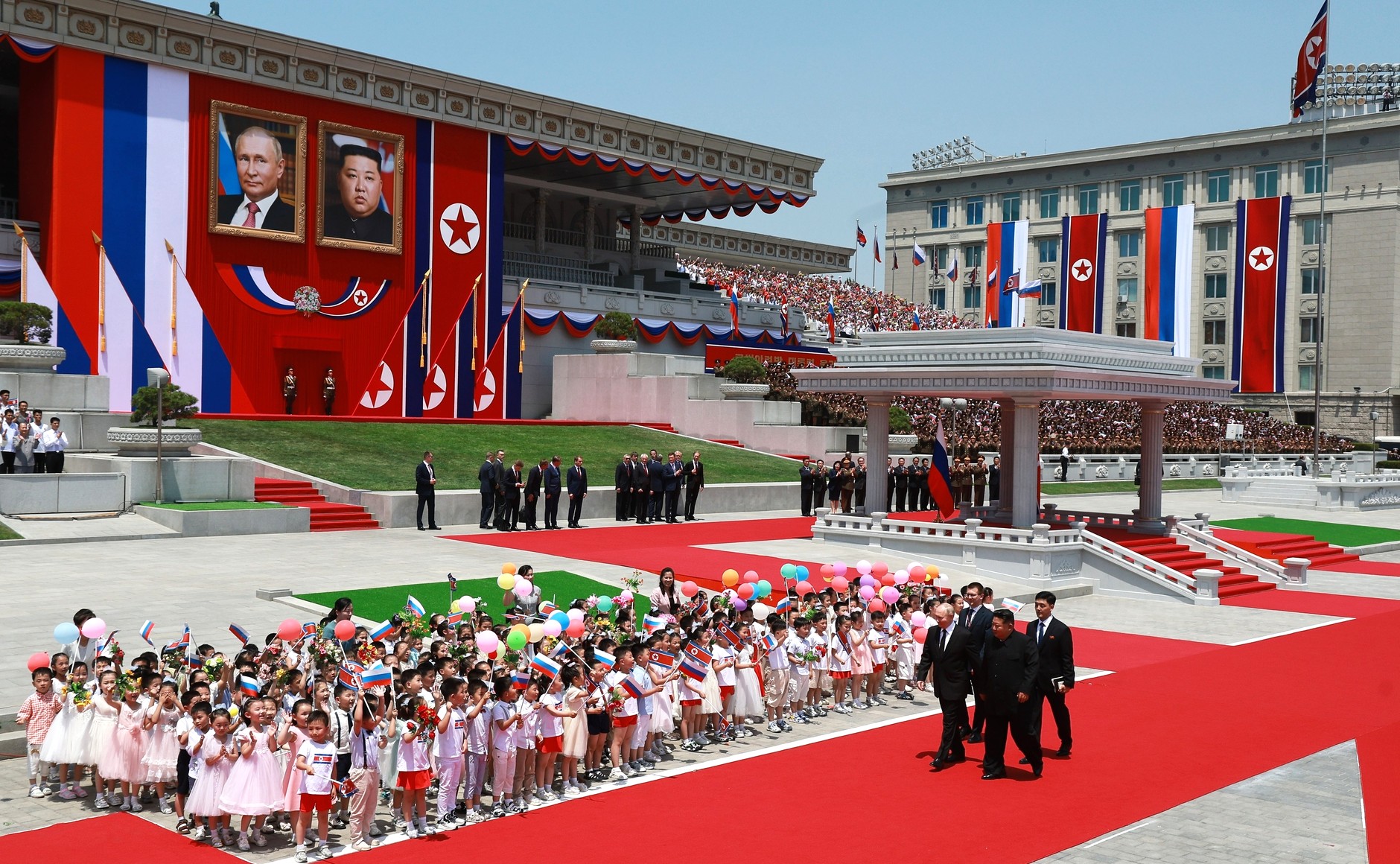
Vladimir Putin and Kim Jong Un are welcomed by the North Korean people, 2024. (Credit: Wikimedia Commons)

China has responded to the strengthened relations between Russia and North Korea cautiously, perhaps with a wary eye as it faces conflicting incentives. On the one hand, it has shown solidarity with its old friends and allies—Russia and North Korea. Beijing has re-engaged with North Korea and vowed to deepen economic, cultural, and military relations with Russia. On the other hand, its reinvigorated relations with Pyongyang are likely driven by China’s fear of losing influence over its ally, North Korea. China has always opposed the hardening of two opposing “blocs,” but its policy toward North Korea has arguably driven that dynamic.
The growing North Korea threat is leading some South Korean politicians, retired generals and security scholars to doubt that Washington would risk Los Angeles to save Seoul and to advocate for an indigenous bomb, or at least the capacity to produce one quickly. Korean President Lee Jae-myung’s government still rejects nuclear armament, favors stronger conventional forces and reassurances over America’s nuclear umbrella, and warns that leaving the Nuclear Non-Proliferation Treaty (NPT) could bring sanctions, damage South Korea’s export economy and provoke Japanese proliferation.
But public opinion in South Korea has long favored acquiring an independent nuclear deterrent, and there is a growing intellectual constituency for moves such as the reintroduction of American tactical nuclear weapons (which were removed in 1991), something that the American and South Korean sides disagreed on sharply during the proceedings.
Seoul also hopes to move towards nuclear-powered submarines. The current progressive government has prioritized their development and has secured Trump’s approval. Nonetheless, how the two sides will work out the details remains unclear. American experts are overwhelmingly skeptical of the military need for Seoul to acquire this capability.
Tokyo, too, is shifting. Japan still relies on its security alliance with the U.S. but amid concerns about the credibility of U.S. commitments, coupled with a more aggressive China, Japan has significantly increased defense spending and adopted a more active security posture over the past several years, investing in long-range strike capabilities, missile defense, space cooperation, and defense industrial partnerships. The Takaichi administration has also softened its stance regarding a revision of the Three Non-Nuclear Principles—not possessing, not producing, and not allowing nuclear weapons to be brought into the country.
Closer cooperation between Washington, Tokyo, and Seoul (who now conduct regular trilateral exercises, exchange missile-warning data, and increasingly treat security on the Korean peninsula, in the Taiwan Strait, and farther afield as interconnected) is seen by China and Russia, not as a response to the challenges they pose to regional order, but the cause of declining trust and division.
Amid so many overlapping risks, “strategic stability” was the catchphrase of the week. In security circles, strategic stability used to be defined, grimly, as a condition in which nuclear rivals could each survive a first strike and retaliate, leaving neither an incentive to attack first or race frantically for advantage. In today’s messier world, the term is associated with preventing crises of all kinds, whether nuclear war, conventional war, cyber war, or even economic war.
But just as deterrence was the guiding logic for preventing war in the old world, deterrence is today viewed as the key to stability. The problem is that one country’s deterrent is another’s provocation. Washington wants allied burden sharing, stronger nuclear forces, missile defenses and better Japanese and South Korean conventional capabilities. Beijing sees many of those same measures as threats, which motivates its nuclear expansion and reluctance to accept traditional arms-control transparency. Moscow, meanwhile, increasingly defines stability as resistance to American predominance, using nuclear threats over Ukraine and military cooperation with North Korea to complicate and stymie Western ambitions.
In other words, every capital claims to seek stability while pursuing capabilities that others experience as destabilizing.
* * *
Months before NEACD first began, on March 12, 1993, North Korea announced its intent to withdraw from the NPT after blocking inspectors from the International Atomic Energy Agency from accessing suspected nuclear waste sites. Pyongyang, however, had no verified nuclear weapons at that time, and its first test wouldn’t happen for more than ten years.
Today, the country possesses an estimated 60 nuclear warheads and enough fissile material to produce at least 30 more, according to the Stockholm International Peace Research Institute.
Whether, given these realities, it is time to forgo the goal of total denuclearization in favor of imposing other, more modest limitations on Pyongyang, was a central question throughout DIS and NEACD. On July 23, South Korean Unification Minister Chung Dong-young said Seoul was aiming to freeze North Korea’s nuclear program and would be willing to offer reciprocal concessions for interim steps rather than demanding the dismantlement of North Korea’s existing arsenal as a precondition for dialogue. The shift in thinking has also been evident in Washington and Beijing. In his second term, Trump has referred to North Korea as a “nuclear power,” a rhetorical departure from long-standing U.S. policy that does not formally recognize North Korea as a legitimate nuclear weapons state. China has also appeared to place less public emphasis on denuclearization.
While a few participants viewed denuclearization as an unrealistic goal, others argued that abandoning the goal of denuclearization would be devastating for the NPT regime.
Stephan Haggard, a North Korea expert, research director at IGCC, and NEACD convenor, noted that “denuclearization” would have to be a stated objective of any deal or dialogue for the U.S. president to participate, but what denuclearization means in practice could be finessed, including through partial deals that reduce risk.
* * *
The question of how economic relations might be weaponized was another subject of vigorous discussion. America has restricted China’s access to advanced chips and manufacturing equipment, and China has answered by pursuing technological self-sufficiency and exploiting its own chokepoints, particularly with respect to rare earths. At their summit in Korea in 2025, Presidents Xi and Trump reached a temporary truce but little further progress was made at the 2026 summit.
Moreover, the conflicts in Ukraine and the Middle East have shown that economics are now inseparable from national security, a perspective participants largely shared. The economic shock following from the Iran war has been a wake-up call for many countries and exposed vulnerabilities they could suffer if “chokepoints” are exploited.
In this new world, assessing national readiness for conflict requires evaluating industrial capacity, societal resilience, and economic mobilization in addition to military capabilities. This was the argument put forth by the IGCC co-director, Tai Ming Cheung, in his concept of “Bello Economics” and the security discussions around technology competition, industrial policy, export controls, supply chain resilience, and economic coercion.
* * *
One of the most interesting questions hovering over the event what the 35 years’ worth of NEACD dialogue has meant—what impact it has had, or failed to have.
“One of the main objectives we always talked about was preventing the emergence of two hostile blocs in the region,” said Shirk at the outset of NEACD, looking decidedly disappointed and as if she were waiting for the room to respond with an answer. “But it looks like we do have two hostile blocs.”
While Shirk remains passionate in her belief that individuals can change histories for the better, and therefore that dialogues like NEACD are valuable in reducing uncertainty and creating long-term relationships of respect and trust, Cheung places more emphasis on the long-term forces shaping history, which are difficult to alter.
What will happen next? It’s hard to know. As one participant noted, in a moment of levity and reference to Yogi Berra, prediction is difficult, especially about the future.
For more insight from this year’s NEACD, check out our special podcast episode: “A Sea of Uncertainty: Reflections from the Northeast Asia Cooperation Dialogue”
Thumbnail credit: Flickr

Global Policy At A Glance
Global Policy At A Glance is IGCC’s blog, which brings research from our network of scholars to engaged audiences outside of academia.
Read More