Democracy, Autocracy, and International Cooperation: Re-Examining the Two-Way Relationship
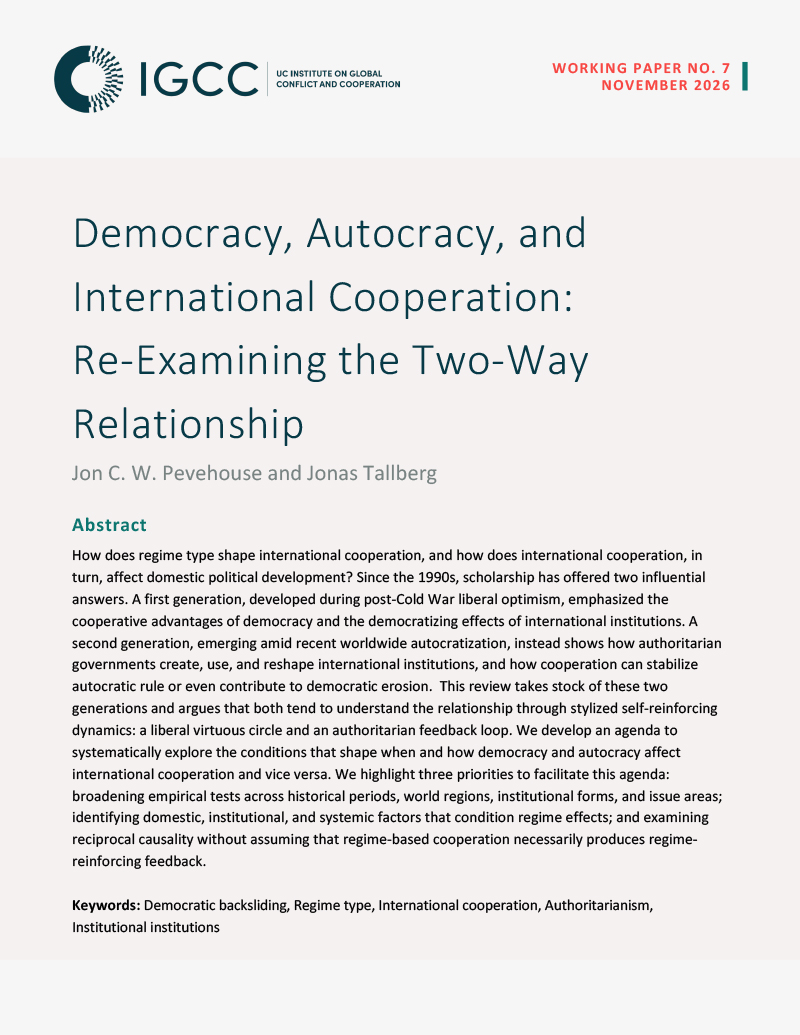
In this working paper, Jon Pevehouse and Jonas Tallberg review existing academic literature and develop an agenda to systematically explore the conditions that shape when and how democracy and autocracy affect international cooperation and vice versa. They also identify three priorities to implementing this agenda: broadening empirical tests across historical periods, world regions, institutional forms, and issue areas; identifying domestic, institutional, and systemic factors that condition regime effects; and examining reciprocal causality without assuming that regime-based cooperation necessarily produces regime-reinforcing feedback.
DownloadHow does regime type shape international cooperation, and how does international cooperation, in turn, affect domestic political development? Since the 1990s, scholarship has offered two influential answers. A first generation, developed during post-Cold War liberal optimism, emphasized the cooperative advantages of democracy and the democratizing effects of international institutions. A second generation, emerging amid recent worldwide autocratization, instead shows how authoritarian governments create, use, and reshape international institutions, and how cooperation can stabilize autocratic rule or even contribute to democratic erosion. In this working paper, authors Jon Pevehouse (University of Wisconsin–Madison) and Jonas Tallberg (Stockholm University) take stock of these two generations and argues that both tend to understand the relationship through stylized self-reinforcing dynamics: a liberal virtuous circle and an authoritarian feedback loop. The authors develop an agenda to systematically explore the conditions that shape when and how democracy and autocracy affect international cooperation and vice versa. They also highlight three priorities to facilitate this agenda: broadening empirical tests across historical periods, world regions, institutional forms, and issue areas; identifying domestic, institutional, and systemic factors that condition regime effects; and examining reciprocal causality without assuming that regime-based cooperation necessarily produces regime-reinforcing feedback.
Thumbnail credit: United Nations (Flickr)