Novels on Authoritarian Rule IV: Summer Reading Edition
Over the last two decades, the social sciences have devoted significant effort to understanding the causes and consequences of authoritarian rule, and the challenges it poses to democracy. Yet fiction provides its own pointed spotlight on these questions. Novels do this in part by explicating specific cases, particularly in closely researched historical fiction. More fundamentally, they consider in close narrative detail the choices made by leaders, the elite allies and challengers who surround them and the citizens caught up in the vagaries of dictatorship.
When we started this project, we purposefully avoided classics in favor of novels that might be somewhat less familiar. But in this first of two summer reading editions of the project, we review influential examples of the genre that remain prescient to this day: Kafka; novels by Koestler, Orwell and Pasternak motivated by the Soviet case; and Isabell Allende’s sweeping historical treatment of the Chilean case, which extends a rich tradition of the Latin American caudillo novel. We always include an American example, and Robert Penn Warren’s All the King’s Men remains to this day one of the best treatments of authoritarian populism. In addition, we consider Golding’s powerful allegorical novel and the profound twists on the theme in Octavia Butler’s Parable series. Much has been written on all of these books, and many—including Koestler and Allende—wrote on the topic well beyond what we showcase here. But in this review, we focus on the particular ways each of these novels sheds light on autocratic rule.
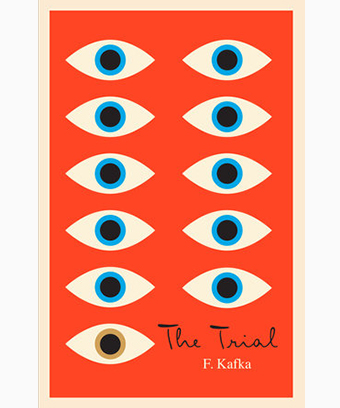
The Trial by Franz Kafka (1994, Penguin, translated by Idris Parry [1925])
Kafka’s The Trial has been read through a variety of lenses, from religious metaphysical allegory to a narrower psychoanalytic—and biographical– portrait of Josef K, its protagonist. In both readings, the theme of judgment, of God or just of others, plays a central role. In the postwar period, however, Kafka was taken as a prescient voice about modern politics and how law is founded on the coercive power of the state.
Once we open this door on the book, though, many paths still remain to be explored. The focal point is the complex apparatus that runs from prosecution and arrest through trial, judgment and punishment. But what type of system is it exactly? Early in the book, Josef K. is surprised by his arrest—which takes place in the first sentence—because “he lived in a country which enjoyed law and order…all laws were upheld; so who dared pounce on him in his own home?” It could be that the trial captures the procedural contradictions that plague the bureaucratic state regardless of its political form, and Kafka was undoubtedly influenced by the Austro-Hungarian legal system of 1910s and its exclusionary anti-Semitism as well.
But whatever those historical influences—or even Kafka’s intentions—the novel captures the opaque legal processes of authoritarian systems. The German-Jewish lawyer Ernst Fraenkel outlined a theory of law in Nazi Germany that sheds light. He argued that the system was dualistic and that a “normative state” with a semblance of rule of legality coexisted with a “prerogative state” that exercises arbitrary power and—in Kafka’s words—is “vengeful.”
The starting point in such systems is the presumption of guilt rather than innocence. The charges against Josef K., and even hints as to what they might be, are never revealed. But one of his arresting officers explains at the outset the core premise: “the high authorities would not order such an arrest without gathering exact information about the reasons for the arrest and the person to be arrested. There’s no reason for mistake.” Needless to say, if there is “no reason for mistake,” the idea of law itself is thrown out the window.
There is no trial in The Trial. Josef K. is interrogated, but without opportunity for defense. There are hints of a distant high court that is fair and just, but there is no route to it. Long sections of the book are taken up with the role of advocates, but they seem as much in the dark as the accused and Kafka suggests they are nothing more than corrupt middlemen who profit by creating the illusion of hope. The line between purely administrative processes—actors and teams “just doing their jobs”—runs through the book and anticipates Hannah Arendt’s treatment of Eichmann.
Ultimately, though, the book rotates around the strategies and psychology of Josef K.; it is a phenomenology of authoritarian law. Josef K. is hardly a rebel or outsider; he has had a successful career at a bank. We can feel his self-confidence—indignantly high at the outset—gradually deflate over the course of the book into fear, anxiety and complicity. The basic decision reduces to whether to admit guilt or not. But admission of guilt does not guarantee exoneration. In another long passage on “the process” a character explains that there is no such thing as a full acquittal, only a partial one (under which arrest is likely to recur) and prolongation. Those outcomes—if in fact possible–would clearly have been better than the ending that transpired. But in authoritarian legal systems, are they really available?
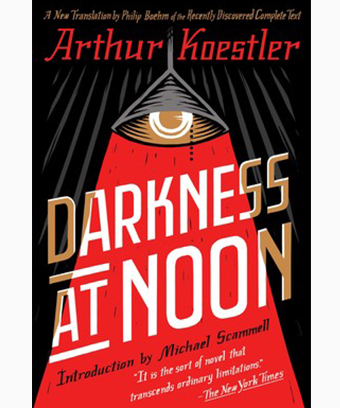
Darkness at Noon by Arthur Koestler (2019, Scribner, translated by Philip Boehm [1940])
“But how can we decide in the present who shall be proven right in the future? We practice the prophet’s craft without his gift.”
Darkness at Noon is one of a trio of novels—including The Gladiators (1939) and Arrival and Departure (1943)—which Koestler wrote about revolutionary morality and the so-called means-ends question. The history of the book is odd, because it first appeared in English from a hastily done translation from the German by Daphne Hardy, Koestler’s girlfriend at the time. The two fled Paris just ten days before the Nazi invasion, but without the original typescript. The accidental discovery of an original version of the manuscript by a German graduate student in 2015 produced a new translation and another cycle of interest in the novel’s intricate philosophical and psychological portrait of high Stalinism.
Darkness at Noon uses the Moscow show trials as a powerful hook. But it would be wrong to read Nikolai Salmanovich Rubashov—the book’s protagonist—as a mere stand-in for Koestler, who had openly defected from the Party by 1938. Rubashov is much more of a true believer, albeit with doubts, and therein lies the drama.
As a novel about authoritarian rule, Darkness at Noon is telling in its exposition of a particular type of political party: a Leninist one that embodies a revolutionary mission, but which claims to ground that mission in science, rationality even truth. That such belief in infallible historical foresight is itself a kind of religion is now painfully self-evident. And that the party is opportunistic, self-serving and unprincipled—with interests completely at odds with the masses–is a central theme of the book. But for the faithful, the implications of an infallible party are profound because to challenge it is not simply a seditious political error but altogether irrational.
The book is built around the interrogation of Rubashov, a high-ranking party member who is arrested in the early pages of the novel on charges which are—as in Kafka’s The Trial—altogether opaque. It gradually becomes apparent that he is accused not only of deviant thinking and participating in the “organized opposition” but of a plot to execute Number One. The very absurdity of the charges tests his loyalty. But so do his reflections on the ruthless way in which the party–including through his own personal actions–made even its loyalists completely dispensable.
At the end of the first interrogation, the central deal on offer is made clear. Rubashov can refuse to say anything, in which case his sentencing and execution would be a purely administrative matter. Or he can agree to participate in a trial in which—for the sake of the party—he will admit to absolutely everything and make an abject plea for mercy. Would Rubashov behave more in line with his emerging principles—battled out in the second interrogation—by rejecting the deal and staying silent? Or should he capitulate, acknowledging the cruel utilitarian logic of which he was a believer? At the start of the third interrogation, he attempts to square the broader moral puzzle by developing a theory of the circumstances under which revolutionary violence is warranted. But the exercise leaves Rubashov torn because part of him still buys into revolutionary principles; needless to say, his theoretical musings are of little interest to his interrogators.
The third interrogation takes place on quite different terms that muddy the story line. His initial interrogator, Ivanov, appealed to revolutionary reason. Now a more thuggish Gletkin is in charge and resorts more openly to coercion to shape and extract Rubashov’s confession. He makes that confession not to save himself, but because he believes his doubts could have schismatic effects. He settles his debt to the party. But in the second half of the novel, he gradually retrieves what Koestler calls “the grammatical fiction” of the “I” vs. the unyielding “we” that goes along with submission to party diktat. In doing so, however, he also appears to conclude that his entire life commitment may have been in error.
If you think such debates were relegated to the dustbin of history by the collapse of the Soviet Union, think again. These conceits emerge around any authoritarian party that justifies its will to power through reference to superior insight. Sadly, such parties persist.
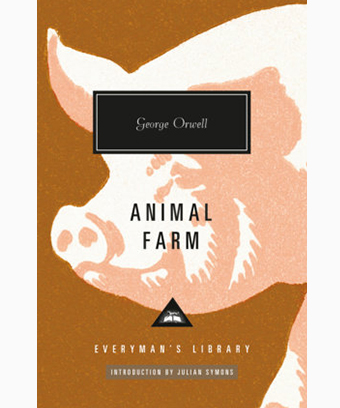
Animal Farm by George Orwell (1946, Harcourt, Brace and Company)
The political ideas which prop up authoritarian regimes are often more stable and enduring than the regimes themselves, and in some cases prove surprisingly impervious to attack. Criticism of the Soviet Union during the first half of the twentieth century left Communist ideas unscathed in many political circles because that criticism came from self-serving conservative forces. George Orwell’s Animal Farm, along with the novels by Koestler, Pasternak, and Solzhenitsyn that we review in this cluster and the next, started to deflate that balloon. Although a product of the post-Fabian socialism of early 20th century Britain and writing sympathetically about the working class in The Road to Wigan Pier, Orwell’s experience of the opportunistic behavior of the Communist Party in Spain infuriated him, and he increasingly saw the Soviet Union’s British defenders as dangerously credulous. The Soviet Union had become something of a political football (the round kind) in British politics during the 1930s. British socialists stood by Russia as an example of a successful proletarian society, even as British reactionaries savaged the country as a dismal failure and mortal threat; at the extremes, a number of British conservatives dallied with fascist and even Nazi ideas.
Orwell’s aim was different: to show that the regime had, voluntarily, abnegated its own principles in order to consolidate of power. In an unpublished preface, he wrote “nothing has contributed so much to the corruption of the original idea of Socialism as the belief that Russia is a Socialist country.” Orwell urged his fellow socialists to apply the same moral standards they applied to their own domestic politics to developments in Russia.
With this aim in mind, Orwell recounts a fairy tale. After hearing an impassioned speech by Old Major, the eldest boar, the animals on Manor Farm rebel against their feeble human masters. After a brief period of revolutionary equality, the felt need for improved social organization–to collect the harvests and keep out the neighboring farmers–leads the animals to endorse leadership by the pigs. Two of them, Napoleon (Stalin) and Snowball (Trotsky), become particularly prominent.
After Snowball’s heroic role in the defeat of a posse of humans, Napoleon begins scheming to remove him. With the aid of a pack of vicious dogs, Napoleon drives Snowball out and puts the animals to work building a windmill. Snowball’s name is constantly invoked as a bogey whenever the animals experience a setback. The draft horse Boxer works himself to death and is sold by the pigs as soon as he becomes useless to their purposes. The revolutionary doctrines painted on the barn wall are secretly changed during the night, and the other animals are reminded that though all animals are equal, “some animals are more equal than others.” Finally, the pigs begin wearing clothes, walking on their hind legs, and drinking whiskey. By this time, none of the animals can remember life before the revolution, but they have the nagging suspicion that their lot has become much worse.
Orwell is clearly outlining the risks of a dictatorship that claims to act in the interest of the people, in this case the proletariat. When power is delegated to—or seized by—a revolutionary cadre capable of exercising repressive control getting it back is no easy task. The pigs are just that: a self-interested elite with little commitment to socialist ideals.
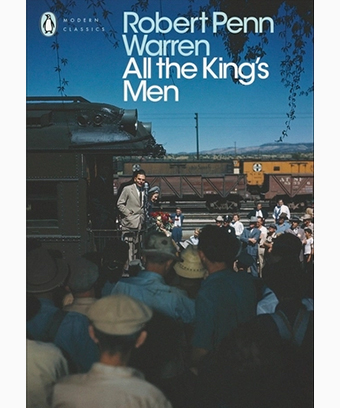
All The King's Men by Robert Penn Warren (1947, Harcourt)
Robert Penn Warren’s American classic is a story about “the kind of doom that democracy may invite upon itself.” In an unnamed state resembling Louisiana, we follow the rise of a populist politician, Willie Stark, whose sudden eruption into state and national politics resembles the career of Louisiana’s governor and senator Huey Long. Cousin Willie from the sticks metastasizes before our eyes into “the Boss,” and what eventually emerges is a thinly disguised personalist—but also populist–dictatorship.
Like Louisiana before Long, Penn Warren sketches a state history in which political choice is severely restricted by machine politics. Citizens can choose between the city machine and the country machine, but elections affect only the distribution of patronage and seldom improve citizen welfare. It is such self-satisfied “democratic” politics that creates the political space for a populist outsider to take the state by storm.
The city machine recruits Stark as a useful idiot to draw support away from the country machine’s candidate. He initially fails to realize that his idealism and sincere concern for the welfare of common citizens are being gracefully and ruthlessly exploited. After a dramatic conversion on the road to yet another small-town speaking engagement, however, Stark undergoes a political metamorphosis that captures the contradictions of populism. He realizes simultaneously that his candidacy is a fraud concocted by the machine, and that the people themselves are contemptible because they refuse to listen to his idealistic speeches about social improvement.
The new Stark (lubricated by a discovered taste for spirits) goes on to rally his rural voters to destroy first the city machine, then the country machine, leaving Stark’s faction firmly in charge. The ease with which the traditional political factions are overthrown bewilders state elites, who attribute Stark’s political victory to grubby measures like vote buying, influence peddling, and literal pork-barrel politics. However, Stark is clearly popular. Penn Warren’s narrator-protagonist Jack Burden plays a critical role as an observer. As he tells his shocked aristocratic family, “If the government of this state for quite a long time back had been doing anything for the folks in it, would Stark have been able to get out there with his bare hands and bust the boys?”
Once in power, though, Stark’s style changes. He stops talking about the policies that need to be enacted, and instead blends identity and grievance politics in a frighteningly modern way (“You ask me what my program is? Here it is, you hicks. And don’t you forget it. Nail ‘em up!”). He also starts taking political shortcuts. Believing himself in a fight to the death with his opponents—as populists do–he has no interest in due process or the rule of law. Byram White, state auditor, has clearly been taking bribes. But as a loyal member of the team he needs to be protected. Bit by bit, checks and balances are swept aside and Stark is left with virtually unchallenged authority.
Penn Warren takes his title from the nursery rhyme Humpty Dumpty, whose protagonist had a great fall and could not be put together again. This fall is ultimately personal as well as political. But Warren’s novel remains one of the clearest expositions of a populist conception of democracy. In Stark’s conception of democracy, the leader stands for the people. But to serve them cannot be bound by procedural niceties. The shocking ease with which Stark suborns state institutions and dominates political life suggests that democracies can consume themselves when popularly-elected leaders move in autocratic directions. One of the most damning steps on the road to this outcome is Stark’s claim that procedural or liberal democracy itself was a sham, which it might well have been. But putting it back together again—both personally and politically–is more of a challenge than bringing it down.
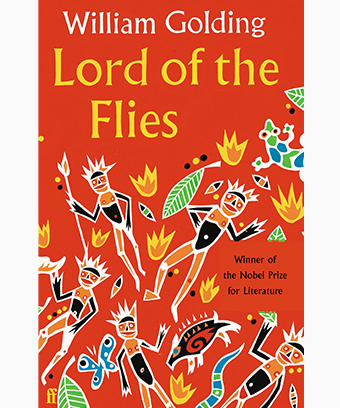
Lord of the Flies by William Golding (1954, Faber & Faber)
Students of authoritarian rule have long asked how such political systems arise. Does the concentration of political power emerge directly from the insecurities in the state of nature (as Hobbes argued), or is it the byproduct of what we call civilization (following Rousseau)? Or is psychology at work, with the unfortunate instances of authoritarian rule traceable to the bad apples among us?
William Golding’s cautionary tale suggests that authoritarian tendencies are latent in any social grouping. Golding wrote his novel partly in response to earlier works, such as The Swiss Family Robinson (1812) and The Coral Island (1857), which depicted cooperation emerging organically without the need for any social or political coordination. Golden is more pessimistic, but his pessimism is only partly rooted in psychology. Rather, he shows that pursuit of self-interest under anarchy—that is, in the absence of coordinating institutions—not only stifles cooperation; it can prevent democratic outcomes and even devolve into gross abuses of human rights.
In Golding’s novel, a plane crash on a remote island leads to the sudden disappearance of political authority, and plunges the community of surviving boys into chaos. The boys are unable to keep a signal fire going to alert passing ships to their plight, and are even incapable of organizing the most basic kinds of cooperation such as hunting and the construction of shelters. The boys divide into mutually hostile camps and, as they approach total self-destruction, are rescued only by a deus ex machina.
Golding’s book has long been viewed as anticipating modern game theory and behavioral economics, or at least illustrating some of its more pessimistic conclusions. Most notably, the mere desire to cooperate is not enough: the structure of a game with self-interested actors matters as well. Golding also anticipates several central findings of evolutionary biology, particularly the existence of behavioral scripts that can generate not only scapegoating but murderous rampages. Even apparently civilized people will, in certain situations, behave with an inhuman savagery if it serve basic survival interests. Golding’s original title, Strangers From Within, reinforces the theme.
The difficulty of building democratic political institutions upon this amoral foundation is obvious. But Golding insists that there is a further obstacle that pertains to potential elites. Any sizeable group of human beings contains several potential leaders, many more than are necessary for group survival. These potential leaders recognize one another as adversaries that present an obstacle to the pursuit of their own interests, including their interests in domination. It follows that not only is democracy foreclosed but reaching any stable authoritarian equilibrium carries the risks of civil war as well.
One of the boys, Roger, is initially restrained in his minor impulses towards violence. But as he realizes that there will be no sanctions for throwing stones at the smallest boys, he metastasizes into a full-blown sadist. The prohibition on violence which Golding calls “the taboo of the old life” gradually fades away, because the social institutions capable of imposing consequences for anti-social behavior are absent.
The boys spend most of their time on the island in terror of a “beast” conjured by their nightmares. It turns out, of course, that the beast was them all along, and early reviews of the novel identified it with the principle that evil is inherent in the human heart. More than half a century of social science later, political pessimists are more likely to emphasize the nature of the game into which they were thrown. Yet Golding’s novel leaves us with its own puzzle: where did the restraining institutions out of which the boys have literally fallen come from? How could they have been constructed in the first place? Golding might say that only by being firmly aware of the beast within—and restraining it–can we build decent and democratic social orders.
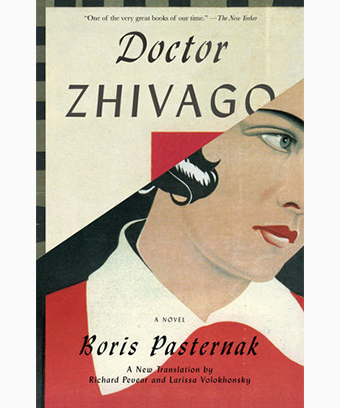
Doctor Zhivago by Boris Pasternak (2010, Vintage, translated by Richard Pevear and Larissa Volokhonsky [1957])
Where to start with this sprawling novel, with its Tolstoyan scale, ambition and cast of characters? As a first pass, it is best read by letting it wash over you. The myriad of coincidences in the book, its many asides and the sometimes-confusing nature of plot are not altogether incidental; rather they form part of the lived experience of war and revolution that Pasternak was trying to capture.
First, a few words on the history of the book. Pasternak devoted a decade to it, and took the gamble of submitting it to a Russian publisher in 1956. The rejection letter is now available and explains pretty clearly Soviet objections despite the nominal thaw following Khruschev’s 1956 speech promising reforms. Zhivago first appeared in Italian translation in 1957. As other translations appeared, it quickly was swept up in Cold War politics, particularly after Pasternak was given the Nobel Prize.
The plot is so well-known—and simple in a way—that it can be summarized briefly. Dr. Yuri Zhivago is a member of the genteel professional/intellectual class, downwardly mobile but with a distinctly elite family tree. Born in roughly 1890, he lives through the revolutions of 1905 and 1917, World War I, the civil war (1917-22) and the Soviet course correction of the New Economic Policy (1921-28). The passionate and tragic love story centers on his infatuation with Lara Antipova. Coming from more enduring poverty she is forever changed by a sexual assault straight out of current headlines. Working as a nurse, she survives the same historical turmoil through her education and compassion. The book ends with a searing Epilogue set in World War II—with its reference to the gulags–and the inclusion of almost 40 pages of “The Poems of Yuri Zhivago,” a concluding testament that weaves together the couple’s personal suffering with Zhivago’s Christian humanism.
Yet the book is less about Yuri’s relationship with Lara or their respective families as it is about how historical forces can upend organic human networks. The novel is political in a nuanced but forceful way, and a clear theme is the consequences—both material and moral–of revolution. Interior reflections and conversations focus on how a thoughtful humanist—and by no means a reactionary—responded not only to war but the capricious repression that accompanied the first 20th century social revolution. The politics in the novel unfolds even more poignantly through the ever-changing context and sense of loss that permeates it: a society ripped apart and ultimately left to destructive natural as well as social forces, from famine and disease to wolves and rats.
We now know that violent social revolutions tend to produce enduring autocratic rule. At the outset, Yuri finds himself caught between the recognized need for social reform and skepticism about the Bolshevik project. Yet a consistent theme is a kind of Burkean conservatism: that social life has organic qualities and that efforts to remold it from the top are not simply bound to fail but defy what life itself is like. As with Koestler, Paternak derides the arrogance of reason.
This theme surfaces in Pasternak’s idea of “giftlessness.” Some revolutionaries in the book are misguided idealists, others are opportunists and Zhivago even develops a rudimentary theory of how revolutions dominated by the first fall victim to the second. But worse than that for Zhivago is that they are “giftless” and mediocre. They have no particular skills—artistic or scientific—and are best at destroying. Through the novel, his impatience with the arrogance and obliviousness of ideology becomes more pronounced, as edicts and directives reference social categories and relations—from “propertied classes” to “peasants”—which no longer make sense. “What must one be to rave year after year with delirious feverishness about non-existent, long-extinct themes, and to know nothing, see nothing around one?”
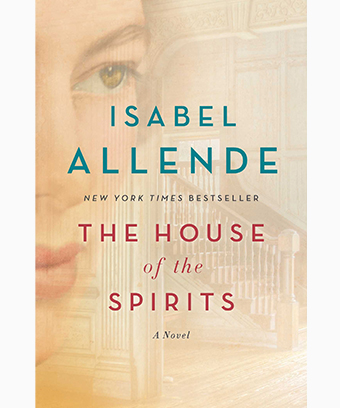
The House of Spirits by Isabel Allende (1982, Atria, translated by Magda Bogin)
It is not surprising that several of Isabel Allende’s novels touch on dictatorship. Her father was a cousin of Salvador Allende, the leftist president of Chile killed during the Pinochet coup, and she herself was forced into exile. A Long Petal of the Sea (2019) follows exiles from the Spanish civil war to Chile and Love and Shadows (1985) is set in the Pinochet era.
But House of Spirits, an inter-generational family saga, plays out the Chilean dictatorship in an arc that reaches back to the early 20th century. The first three quarters of the novel does not appear to be overtly political, but don’t be fooled. The narrative rotates around the rigid conservative political views of Esteban Trueba and the complex counterpoint to the posed by his more liberal wife Clara. He is a classic patrón in his domain, an estate that had fallen into disrepair that he revives. He speaks the self-justificatory ideology of classic patriarchy: how he provides for the native peasants who would be lost without guidance. Class and indigenous origins are subtly interwoven throughout. But he is also an angry, casual and violent sexual predator. The restoration of his estate plays off social developments in the inter-war period that bring ideas of socialism, labor and peasant rights, and demands for social justice.
What at first appears to be a narrative centered on a patriarchal landlord family is undergirded not only by the family’s fascinating and eccentric women—where Allende’s magical realism shines through–but an equally complicated intergenerational narrative of the Garcia tenants. The Garcia family ranges through the generations from trusted hands–interwoven by rape and affairs—to increasingly resentful cohorts seeking not just social justice but revenge.
The portions of the book dealing with the coup and dictatorship are closely observed, starting with the polarization following the surprise victory of Allende in the 1970 election. As Allende puts it, on the date the left “calmly came to power…the right began to stockpile hatred,” gradually turning from legal means of political opposition to an embrace of illegal ones. The missteps of the new left government contribute to an economic crisis that fuels class conflict; Allende captures the ideological differences on the left between idealist revolutionaries and more cautious reformers.
But one striking theme is the way that the conservatives pop champagne in response to the coup, thinking the military will serve as their agents. They swiftly realize that they have their own distinctive objectives and methods, including the brutality for which the Southern Cone dictatorships of the 1960s and 1970s were known. There is so much more to this rich book than the politics, including the bonds that tie disparate generations together and the inexplicable factors that generate love. But there can be little question that the book builds toward an understanding of the social origins of dictatorship and how the political trauma of dictatorship and violence can and should be overcome.
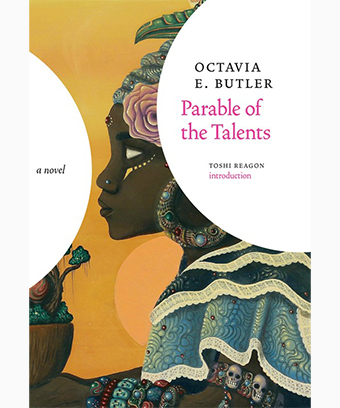
Parable of the Talents by Octavia Butler (1998, Seven Stories Press)
Parable of the Talents is a dystopia within a dystopia. Parable of the Sower (1993), which initiated an unfinished series, tells the story of a 2020’s America ravaged by climate change, inequality, and the collapse of basic social services; war with Canada and an independent Alaska also looms in the background. The world is an Hobbesian one, with internally displaced people wandering California in search of work and predators and traffickers exploiting their vulnerability.
Talents adds the rise of a Christian nationalist politician, Andrew Jarrett, who plays off rising social discontent to win the presidency on a platform of making America great again. Butler captures the way radical rhetoric can produce violence, not only directly but by empowering extremists. In this case an offshoot of Jarret’s Christian America movement called the Crusaders takes on the re-education of “the traitors and sinners, those destroyers in our midst.” The means of control combine brutal camps with technologies like electronic “collars” that invoke slavery and the whip. Traditionalist ideas about gender and sexuality coexist hypocritically with rape and the separation of children from their corrupted parents.
It is the identity of the victims that motivates the storyline and brings a distinctive twist to the genre. As in a number of other dystopian novels we review, the story is told in whole or part through preserved or found texts that seek to bear witness to the violence and indignities emanating from extremist movements. Larkin, separated from early childhood from her parents in a makeshift re-education camp, is reading texts and diaries written by her quietly charismatic mother Lauren Oya Olamina and weaving them into a narrative of her life as well. Olamina is the founder of a religion—sect or cult to its detractors—called Earthseed, which provides an adaptive humanist response to social breakdown and environmental disruption. Central to the religion is the forging of sustainable community, Acorn, that is both progressive and self-protective; all chapters begin with short religious passages that in combination outline a worldview.
The dramatic arc of the book centers on families both separated and politically divided and in constant search for one another, like a great diaspora. Yet much of the book is taken up with the challenges of resistance and survival, both physical and moral, that we find in novels of slave escape as well. The Huntington Library near Pasadena houses Butler’s papers and numerous drafts of her efforts to write the third installment. Yet even without those novels, the Parable series and Butler’s other work had profound influence on Afro-futurist fiction that taps memory but focuses on the possibilities for social justice. That influence stems from her ability to combine a harrowing focus on social violence and victimization with the promise of redemption not in the afterlife but—through purposeful action—in this one.
Matthew Draper is a Ph.D. candidate in the department of political science at UC San Diego, and incoming assistant professor of political science at Dickinson College. Stephan Haggard is distinguished research professor at the UC San Diego School of Global Policy and Strategy and research director for Democracy and Global Governance at IGCC.
Further Reading
Novels on Authoritarian Rule I

Global Policy At A Glance
Global Policy At A Glance is IGCC’s blog, which brings research from our network of scholars to engaged audiences outside of academia.
Read More