IGCC’s Public Policy and Nuclear Threats Concludes its 22nd Year of Training
After nearly two weeks of intensive discussions, expert lectures, and hands-on policy exercises, the 22nd annual Public Policy and Nuclear Threats (PPNT) Boot Camp concluded this week at IGCC, graduating a highly selective cohort of just 32 early- and mid-career nuclear security professionals chosen from nearly 150 applicants.
Convened since 2003 on the campus of UC San Diego, PPNT brings together leading experts in nuclear security policy to prepare the next generation of scholars and practitioners for careers at the center of policy and practice. That mission is increasingly urgent: this year’s program was held amid a turbulent geopolitical environment characterized, in the nuclear security realm, by the expiration in February of New START, an accelerated drive for modernization, and a deadly war in the Persian Gulf.
Throughout the program, participants lived and learned together in La Jolla, engaging directly with policymakers, scientists, and national security experts while exploring the technical, strategic, and political dimensions of nuclear threats.
“PPNT is not a conference, and it is not simply a class,” said Neil Narang, PPNT program director and co-director of IGCC at the opening dinner. “It is a residential invitation into a professional community – one designed to last for the rest of their careers.”
This year’s boot camp opened with a keynote address by Thom Mason, Director of Los Alamos National Laboratory (LANL) and Adjunct Professor at UC San Diego, who remained with the cohort for several days; it concluded with a closing keynote from Kim Budil, Director of Lawrence Livermore National Laboratory (LLNL)—providing high-level engagement from the leaders of the two UC-managed nuclear weapons laboratories. It also featured lectures from an exceptional group of speakers, including Sulgiye Park who lectured on North Korea; Elaine Bunn on extended deterrence; Rebecca Davis Gibbons on proliferation; Laura Holgate on international and physical security; Heather Williams on nuclear taboo and the Nuclear Ban Treaty; Tong Zhao on China; Toby Dalton on India and Pakistan; Michael Kimmage on Russia; and Chris Inglis on cyber, among others. Sessions examined a wide range of topics, from international safeguards and legal and ethical issues to stockpile stewardship, weapons modernization, and emerging challenges involving cyber threats, artificial intelligence, space security, nuclear terrorism, and strategic stability.
“PPNT is intentionally small, selective, and interdisciplinary,” said Narang. “We maintain a roughly 50-50 balance between participants with STEM and technical training and those trained in policy and the social sciences. The point is to make them fluent in one another’s questions.”
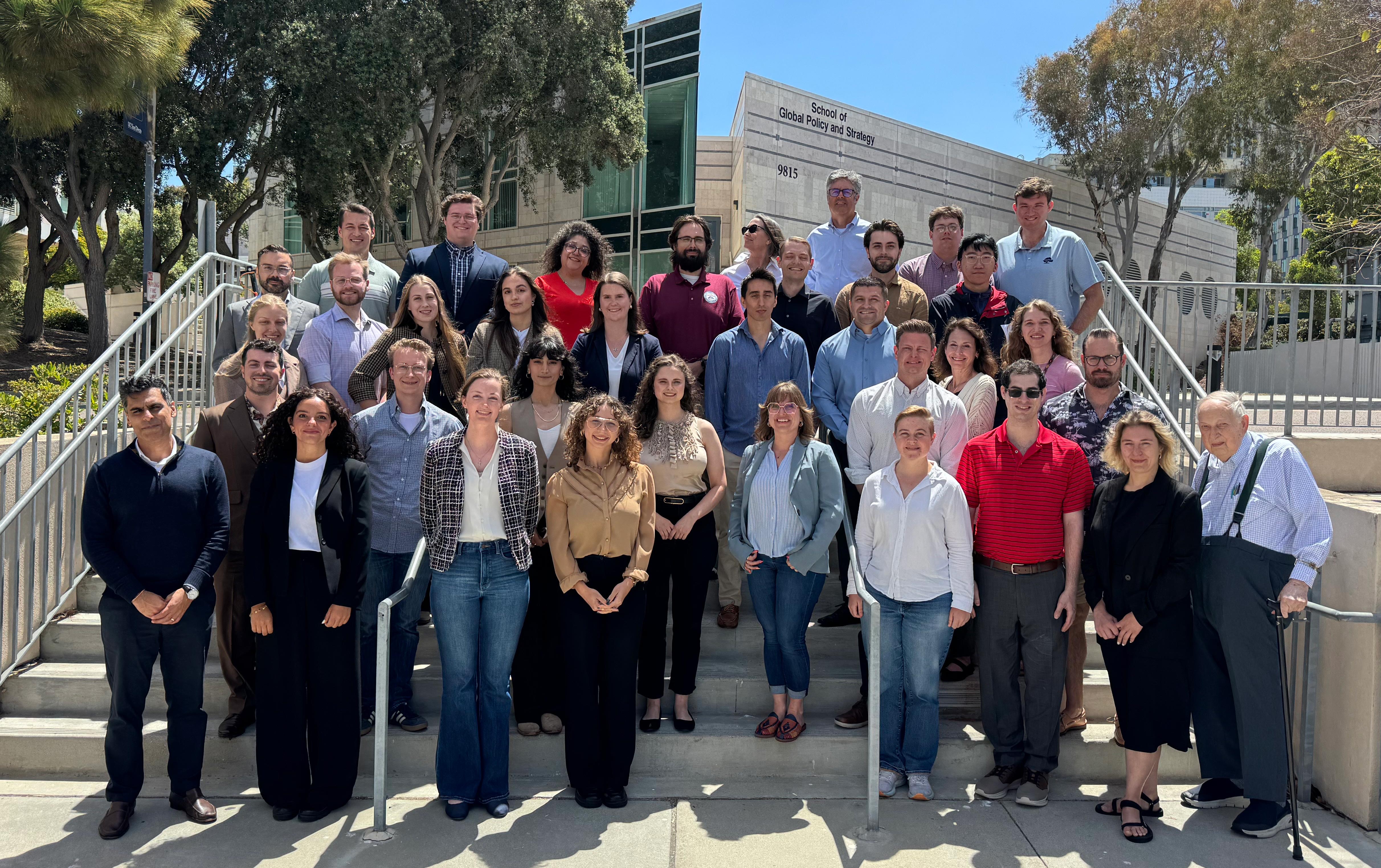
Participants and leadership of the 2026 PPNT Boot Camp
A hallmark of PPNT is its interdisciplinary approach, bringing together participants from diverse academic and professional backgrounds to examine complex nuclear policy challenges from multiple perspectives. This year’s cohort included an atypically large group of about a dozen LANL professionals, selected across scientific, engineering, operational, policy, and communications backgrounds for their diverse experience and potential future contributions. They joined professionals from LLNL, the National Nuclear Security Administration, the Air Force, and the Navy, alongside graduate students and nonprofit researchers whose participation was made possible by support from Longview Philanthropy. The program concluded with its signature policy simulation, giving participants the opportunity to apply what they had learned to realistic scenarios modeled on the kinds of decisions faced by senior national security officials.
“PPNT has helped me expand the breadth and depth of my knowledge in the nuclear field, build on my technical expertise with a policy focus to become more well-rounded, and develop my communication skills with policy and decisionmakers,” said Nicole A. DiBlasi, a scientist at Los Alamos National Laboratory. “In an increasingly complex geopolitical landscape, mutual understanding, motivation, and dedication of nuclear practitioners is invaluable. I am honored to have been included in such an impressive cohort for this remarkably impactful educational program.”
Part of what makes PPNT special—and unlike any other nuclear security training experience—is the relationships formed among participants over the nearly two weeks that the group lives and learns together in La Jolla. With plenty of time for lingering discussions over meals, morning runs on the beach, and games of nuclear trivia, the program places a premium on real human relationships and human judgment as it prepares cohorts for an increasingly fractured world. Speakers often remain beyond their formal sessions, joining meals and continuing conversations with participants. Together with the JASON summer study, PPNT helps make La Jolla something of a “Davos of nuclear security” each summer, bringing laboratory directors, ambassadors, former CIA and Pentagon leaders, and leading scholars into the same orbit—in lecture halls, over meals, and in hotel corridors.
In the words of Amb. Linton Brooks, “The people who run nuclear security programs have to be humans, not just knowledge machines”—and the design of PPNT reflects that.
Brooks, a former Administrator of the National Nuclear Security Administration and Scholar-in-Residence of PPNT, has provided the intellectual leadership of the program since 2008, designing the curriculum and identifying speakers. The program is directed by Neil Narang, co-director at IGCC and associate professor of political science at UC Santa Barbara.
The 2026 cohort now joins more than 550 PPNT alumni who have risen to senior ranks across government, academia, the national laboratories, philanthropy, and private industry, including LLNL Director Kim Budil, former senior White House official Mira Rapp-Hooper, CSIS Project on Nuclear Issues Director Heather Williams, and leaders such as Huban Gowadia, Francesca Giovannini, and David Santoro.
Funding for this year’s PPNT was provided by Longview Philanthropy, whose timely support allowed the program to proceed after previously awarded NNSA support was frozen. IGCC is seeking restoration of that federal funding to sustain PPNT at a time when the need for next-generation nuclear security talent is acute. The program also receives more competitive applications from Europe than it can currently accommodate; IGCC’s longer-term ambition is to develop a dedicated PPNT in Europe with allied and partner institutions.
Now in its third decade, PPNT continues to serve as one of the nation’s premier—and most selective—training programs in nuclear security policy, equipping emerging leaders with the knowledge, professional networks, and practical experience needed to address some of the world’s most pressing security challenges.